
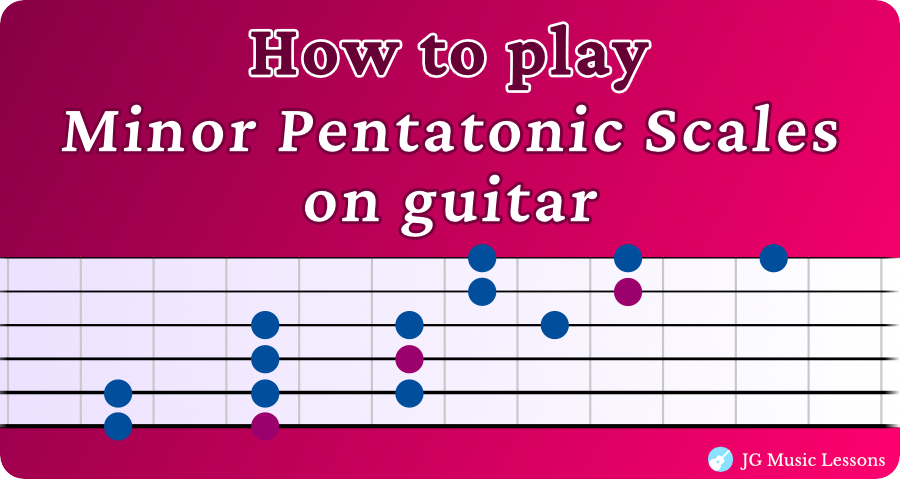
The minor pentatonic scale is one of the most powerful and widely used scales on guitar. With only five notes, it creates a dynamic, expressive sound that shows up in countless songs across rock, blues, pop, and beyond.
Whether you want to jam confidently over a backing track, add emotion to your solos, or simply sound more musical when you improvise, this scale is essential.
In this lesson, you’ll learn:
- All five minor pentatonic scale shapes (with tabs and audio)
- How to connect them smoothly across the entire fretboard
- Practical patterns and licks to help you make music with them, not just memorize shapes
Each section includes guitar tabs and audio examples so you can follow along and hear exactly how it should sound.
🎸 Grab your guitar and let’s dive in!
✨ This PDF is included free with Pro Membership
Minor Pentatonic Scale Formula
Let’s first go over some basic music theory behind the minor pentatonic scale before learning the shapes. The 5 scale notes in the minor pentatonic scale are the root, flat 3rd, 4th, 5th, and flat 7th scale degrees. You can think of these as notes which come from the minor scale.
The following formula shows you the distance between each note of the scale. You can use this formula to start on any root note. Whole steps are abbreviated to ‘w’.

All minor pentatonic scales use this same formula (1.5w, w, w, 1.5w, w). For example, using this formula, an A minor pentatonic scale has the notes A, C, D, E, and G.
Minor Pentatonic Scale Chart – All Keys
The following chart shows what notes belong the minor pentatonic scale starting on all 12 root notes.
| Minor pentatonic scale | 1 | b3 | 4 | 5 | b7 |
|---|---|---|---|---|---|
| C minor pentatonic scale | C | Eb | F | G | Bb |
| D minor pentatonic scale | D | F | G | A | C |
| E minor pentatonic scale | E | G | A | B | D |
| F minor pentatonic scale | F | Ab | Bb | C | Eb |
| G minor pentatonic scale | G | Bb | C | D | F |
| A minor pentatonic scale | A | C | D | E | G |
| B minor pentatonic scale | B | D | E | F# | A |
| Db minor pentatonic scale | Db | E | Gb | Ab | B |
| Eb minor pentatonic scale | Eb | Gb | Ab | Bb | Db |
| Gb minor pentatonic scale | Gb | A | B | Db | E |
| Ab minor pentatonic scale | Ab | B | Db | Eb | Gb |
| Bb minor pentatonic scale | Bb | Db | Eb | F | Ab |
Relation to the Major Pentatonic
💡 Did you know that the Major and minor pentatonic scales are related to each other? By starting on the second note of the minor pentatonic scale you actually play the same notes of the Major pentatonic scale.
For example, an A minor pentatonic scale has the same notes as a C Major pentatonic scale. Another example, an E minor pentatonic scale contains the same notes as the G Major pentatonic scale.
As a side note, the formula for the Major pentatonic scale includes these degrees: 1, 2, 3, 5, and 6. All we’re doing is shifting the way you look at the starting point.

You can also check out this other lesson for an overview of both Major and minor pentatonic scales.
Where can you use the minor pentatonic scale?
The minor pentatonic scale can be used anywhere you would play a minor scale. For example, try an A minor pentatonic scale where you would normally play an A minor scale. You can think of the minor pentatonic scale as the minor scale without the 2nd, and 6th degrees. ‘H’ represents half steps between two notes.
You can compare these two scales in the chart below.

Minor Pentatonic Scale Shapes
Because the same notes repeat across the fretboard, the minor pentatonic scale can be played in five different shapes. Learning all five gives you the freedom to play anywhere on the neck — not just in one position.
These shapes are movable, meaning they shift depending on the key you’re playing in. Each shape connects to the next, letting you move smoothly up and down the fretboard.
You can use any root note to play these shapes. After we cover the shapes, we’ll dive into real musical examples in different keys so you can start using them right away.
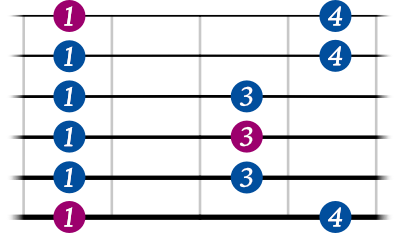
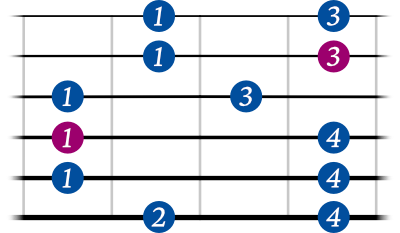
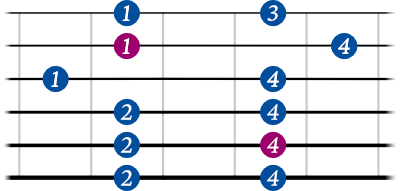
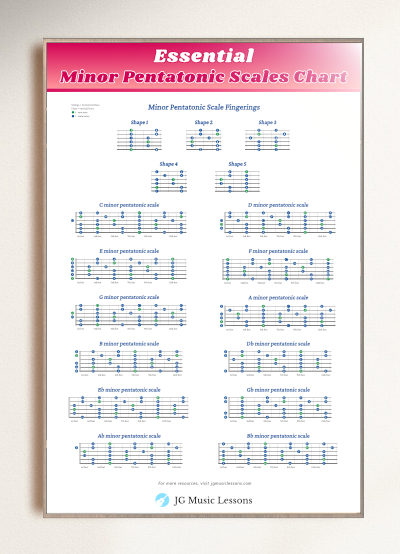
How to read the scale charts
For the charts below:
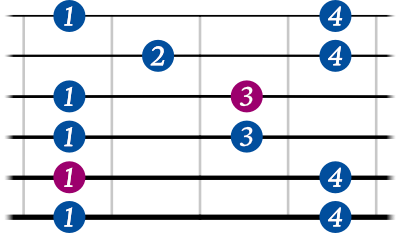
- The lowest horizontal line represents the thickest string (Low E). The top horizontal line represents the thinnest string (high E).
- The purple circles represent the root note of the minor pentatonic scale and the blue notes are every scale note in between.
- The numbers inside the circles represent the suggested fingering to use on your fretting hand.
If needed, check out how to read guitar notation symbols.
Shape 1
Shape 2
Shape 3
Shape 4
Shape 5
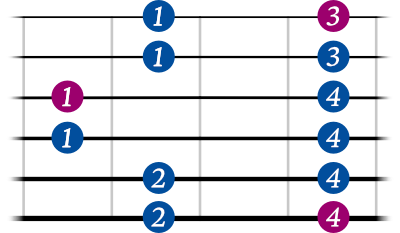
When you play these shapes in keys that include open strings (like E minor or A minor), you’ll need to adjust your fingering slightly.
For example, if a shape normally uses fingers 1 and 4 on a string, you can play the open string instead of finger 1, then use finger 3 for the higher note.
So while you’ll have to modify a few fingerings when open strings are involved, the overall pattern stays the same. Once you shift up the fretboard (where all notes are fretted), you’ll return to the original shapes as shown here.
Minor Pentatonic Scale Examples
In this section we’ll apply the five pentatonic scale shapes to different keys including audio files. I highly recommend you learn the notes on the fretboard to be able to shift the scale shapes to any key.
Note that these examples will not all start on the root note so that you can practice learning different scale shapes.
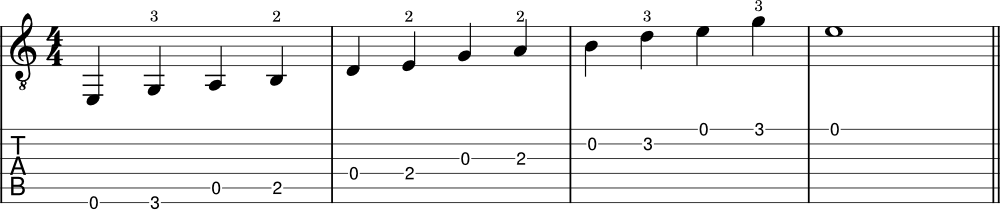
E minor pentatonic scale
This first example of the E minor pentatonic scale follows scale shape 1 but the fingering is adjusted because of the open strings. As mentioned earlier, if you use open strings, fingering 1 and 4 would become 0 and 3.
C Minor Pentatonic Scale
This example also follows shape 1 and now includes all fretted notes which we saw in the original shape 1 chart.
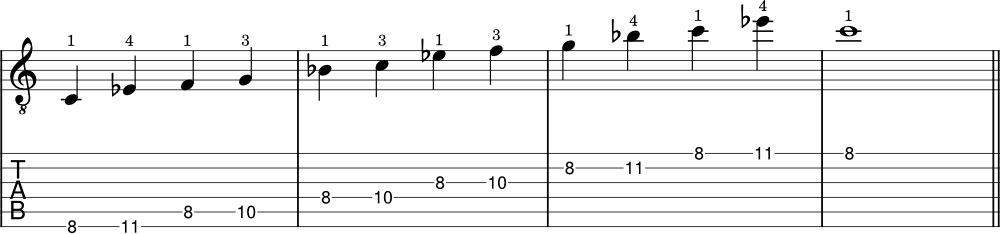
G Minor Pentatonic Scale
This is an example of a G minor pentatonic scale using shape 2.
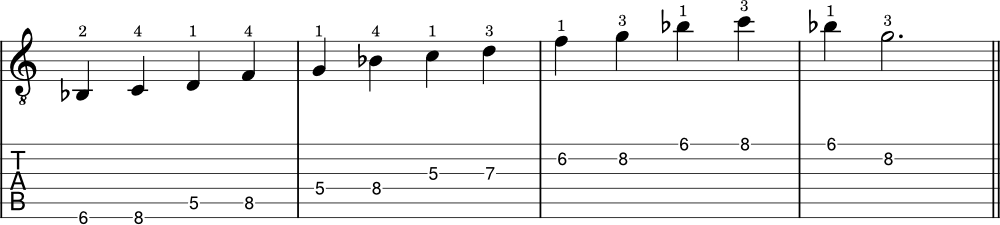
D Minor Pentatonic Scale
This is a D minor pentatonic scale using shape 3.
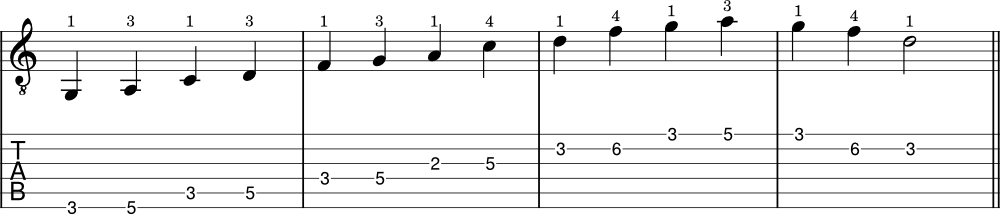
F Minor Pentatonic Scale
This is an F minor pentatonic scale using shape 4.
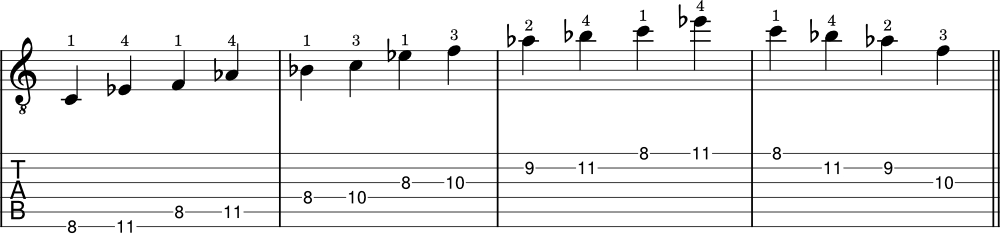
A Minor Pentatonic Scale
This is an A minor pentatonic scale using shape 5.
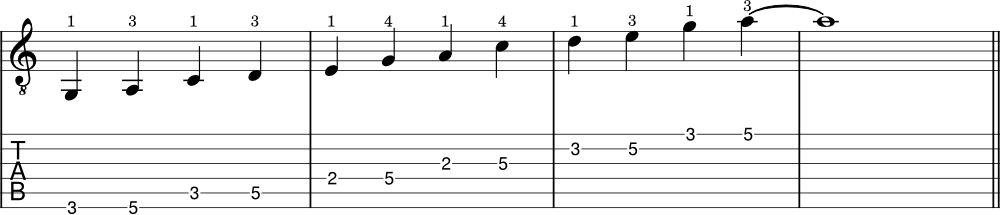
Connecting Minor Pentatonic Scale Shapes
After learning the 5 scale shapes, we also want to be able to connect them throughout the fretboard.
This section gives you some ideas of how you can connect the shapes we covered using repeating patterns with similar fingerings.
Again, you can choose any root note for these connecting shapes wherever it’s applicable to fit these on your fretboard, and always adjust fingerings and notes if you are using open strings.
Minor Pentatonic Connecting Shape 1
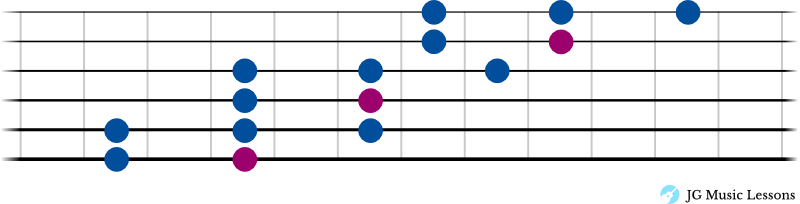
Here is an example of the connecting shape 1 using the A minor pentatonic scale.
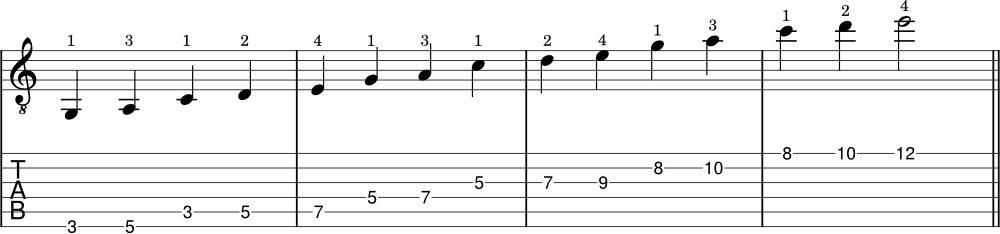
Minor Pentatonic Connecting Shape 2
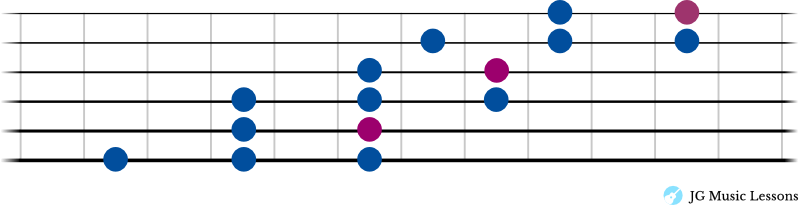
Here is an example of the connecting shape 2 for an E minor pentatonic scale.
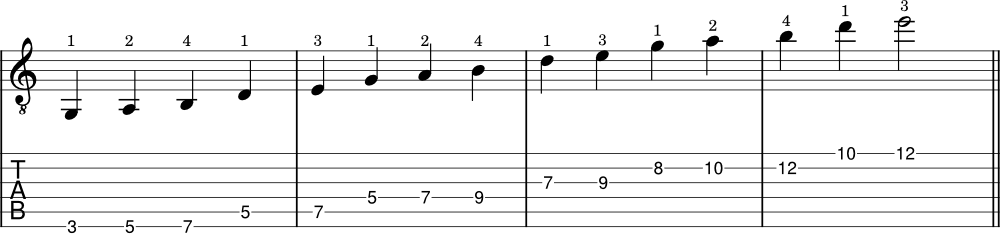
Minor Pentatonic Scale Patterns
These patterns are different ideas that you can use to practice the minor pentatonic scales after learning the shapes. These pentatonic patterns can help you explore ways to make the scale sound more musical as opposed to just playing up or down the scale.
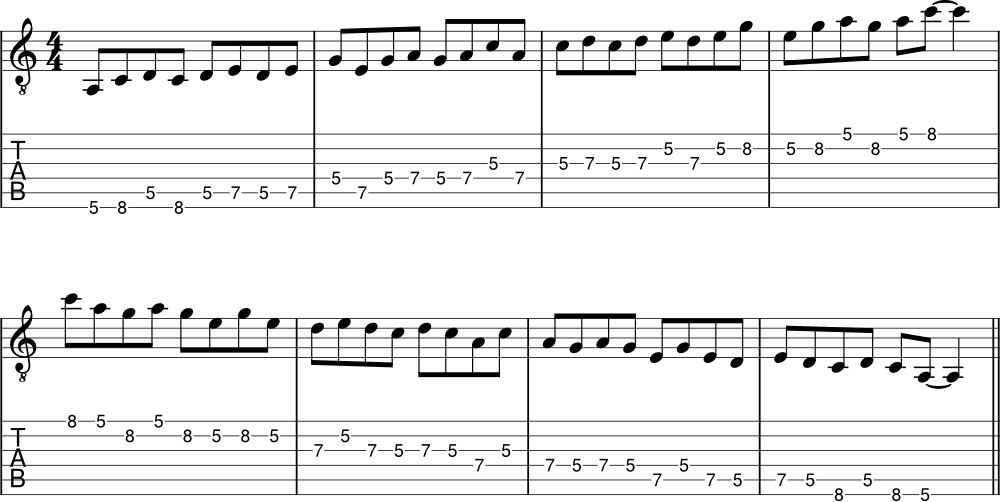
These examples will be based on shape 1 of the A minor pentatonic scale.
Consecutive 3 Note Pattern

3 Tips for Memorizing the Pentatonic Scale Shapes
1. Master One Shape at a Time
The way I recommend learning and memorizing these scales is to start memorizing one shape that feels most comfortable for you. Try to really get the shape under your fingers to the point of not having to look at the chart. Use the first shape you master as a guide to learn the other scale shapes around it.
2. Look for Repeating Fingering Patterns
Try to think of patterns such as what strings repeat the same fingering within a shape. For example, if a certain string set has a pattern of 1, 3, and 4, which other strings follow the same pattern? Or think of which strings only include 2 notes within a shape.
Quick tip: The notes on the first and sixth string will always be the same.
Knowing where note patterns repeat will help you build a mental map of a scale shape.
3. Connect Shapes Around the Ones You Learned
After getting one of the shapes down really well, either learn the shape that comes before or after it to see how the scale connects on the fretboard. Again, try to master one shape at a time and make sure you can play it without looking at the chart. This will make the process more approachable by breaking it down into smaller sections before moving on to the next shape.
Bonus: Minor Blues Scale Formula
If you want to make the minor pentatonic scale sound more bluesy, you can simply add one half step note in between the 4th and 5th degree to play a minor blues scale.
The formula for a minor blues scale is 1, b3, 4, #4, 5, and b7.

For example, the A minor blues scale includes the notes A, C, D, D#, E and G.
To learn about this scale more in-depth, check out this lesson on how to play the blues scale on guitar.
✨ This PDF is included free with Pro Membership
Wrapping up
The minor pentatonic scale is one of the most versatile tools you can have as a guitarist. Once you know all five shapes and how they connect, you’ll be able to solo confidently in any key, across any part of the fretboard.
Play these shapes over a backing track. This helps you hear how each note sounds in context and trains your ear to recognize which notes create tension, resolution, or emotion. That’s where real musicality comes from: not just knowing the shapes, but knowing how to use them.
The more you practice with music behind you, the faster you’ll move from memorizing patterns to actually making music.
To learn more, check out these 9 tips to get better at improvising on guitar.
📘 Get the free guitar practice guide here!
All the best,
JG Music Lessons
Start Playing Better, Faster
with Pro Membership! ✨
Get the guidance, tools, and support that keep your progress on track:
🏁 Always know what to practice next. Access the full Guitar Learning Roadmap with lessons in sequence.
🎼 Play songs with confidence. Step-by-step lessons of popular, classical pieces and other styles.
📙 Save time and frustration. Clear PDFs and ebooks that save time so you can focus on playing.
🎟️ Get rewarded for consistency. 2 free downloads every month (a $240+ yearly value).
🎁 Keep costs low while you grow. 50% off all charts, tracks, and posters — up to 75% off bundles.
🚫 Stay focused. Ad-free environment keeps you in the zone.
💬 Get help when you need it. Direct member support to keep you on track.