
Have you ever seen a slash chord like D/F# or G/B in a song and weren’t sure what to do with it?
Good news, it’s simpler than it looks. Slash chords are a quick way to make your chord progressions sound smoother and more musical.
In this lesson, you’ll learn what they mean and when to actually reach for them.
Included in Pro Membership ✨
What is a slash chord?
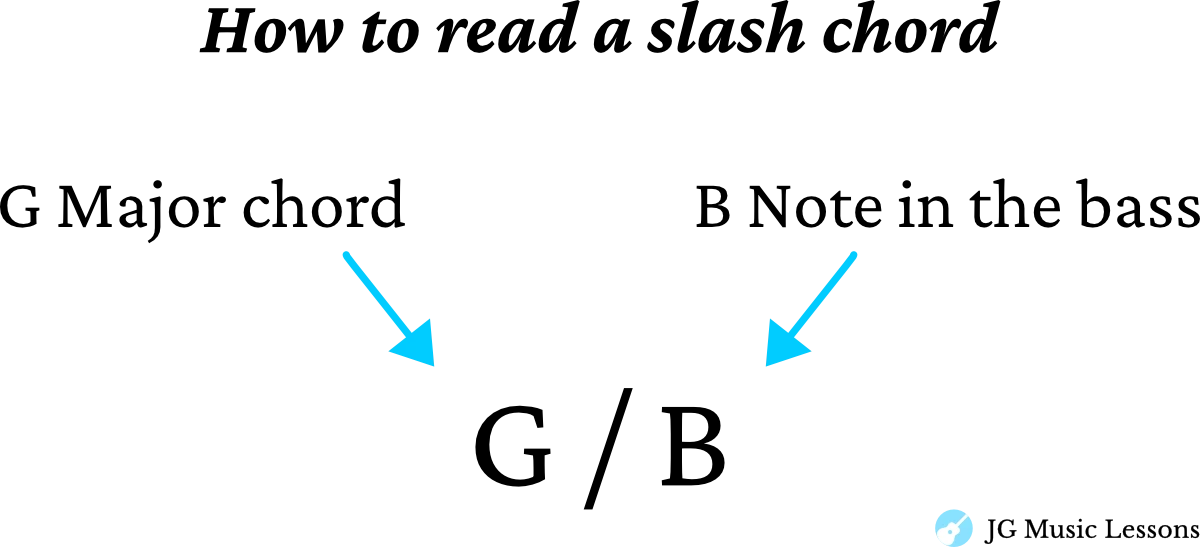
A slash chord is a chord with a specific bass note.
The note on the left is the chord.
The note on the right is the bass note.
G/B means you play a G chord, but B is the lowest note.
A G chord contains G, B, and D.
With G / B, B becomes the bass note instead of G.
Compare the open G Major chord with a G/B chord below.
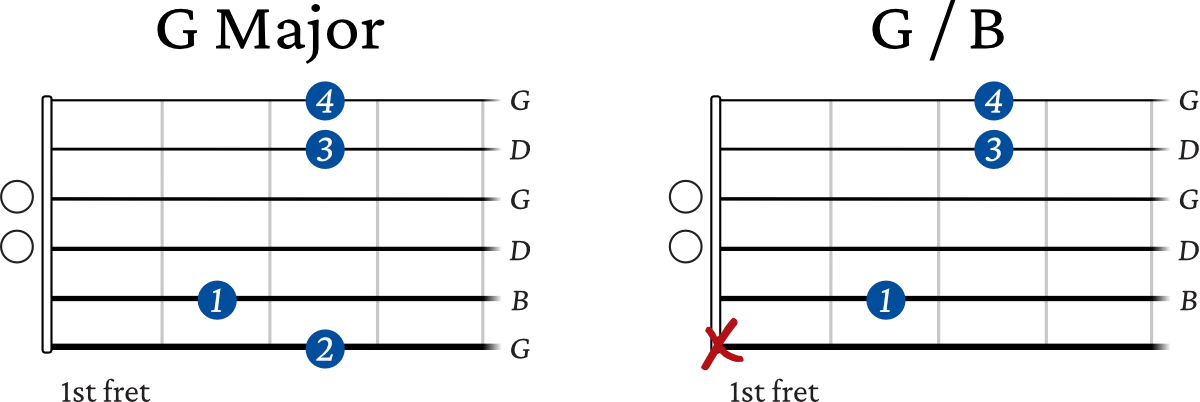
When you change the bass note like this, you’re often creating what’s called a chord inversion. That simply means a chord tone other than the root is in the bass.
If needed, review this lesson on triads to know what notes belong in a chord.
Examples of slash chords on guitar
Here are some examples of slash chords on the guitar in first position. These are based on basic chords you likely already know. Notes in parentheses are optional.
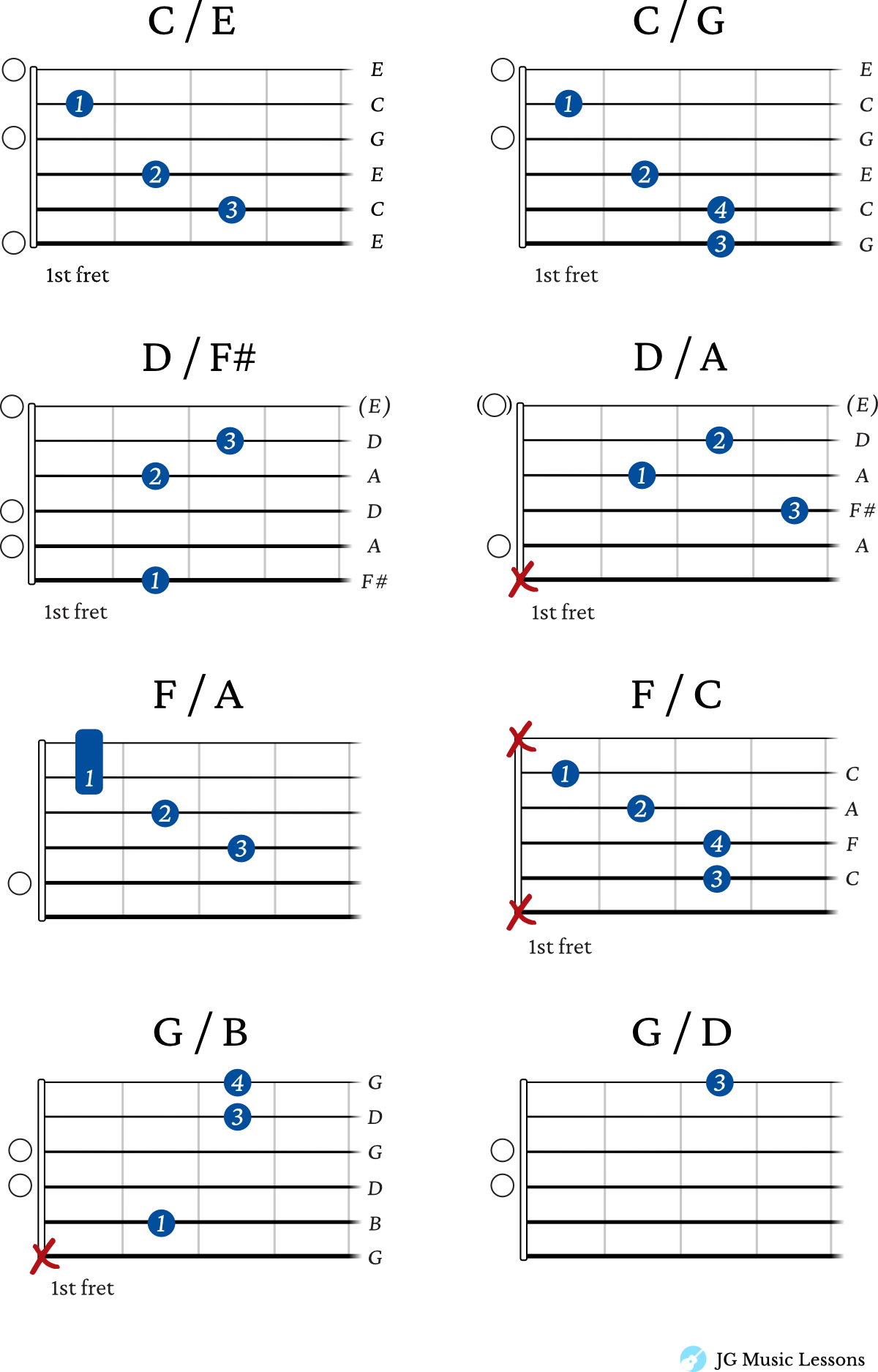
To go further with inversions, see this lesson.
Are all slash chords inversions?
Not all slash chords are inversions. An inversion uses a chord tone in the bass. C/G is an inversion because G belongs to the C chord. C/F is not, because F is not in a C chord. It just means play a C chord with F underneath.
Why use slash chords?
Slash chords are useful for three main reasons:
- Creating smoother transitions between chords
- Simplifying complex chord names
- Holding a steady bass note while chords change (aka chord pedals)
We’ll walk through each. Before that, here’s a quick clarification on the bass vs root note.
Bass note vs root note clarified
The bass note is the lowest note you play.
The root note is the note the chord is built from.
For example:
For C/E, you’re playing a C chord, but E is the lowest note.
The root is still C.
The bass note is E.
1. Slash chords as passing chords
Use slash chords when a chord progression feels jumpy or static and you want it to flow.
Example 1a
One of the most common uses is to connect chords more smoothly.
For example, instead of: C → G → A minor 7 → G
You can play:
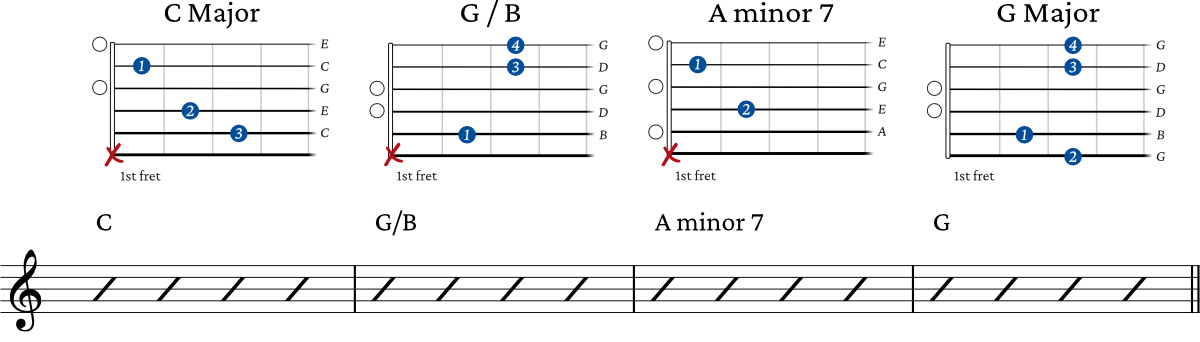
Now, the bass line moves step by step down the C Major scale:
C → B → A → G
That small change makes the progression feel more connected. Try both versions and listen to the difference.
Example 1b
Here’s another example of a passing slash chord in the key of G. Instead of C → D → G, you can use slash chords like this:
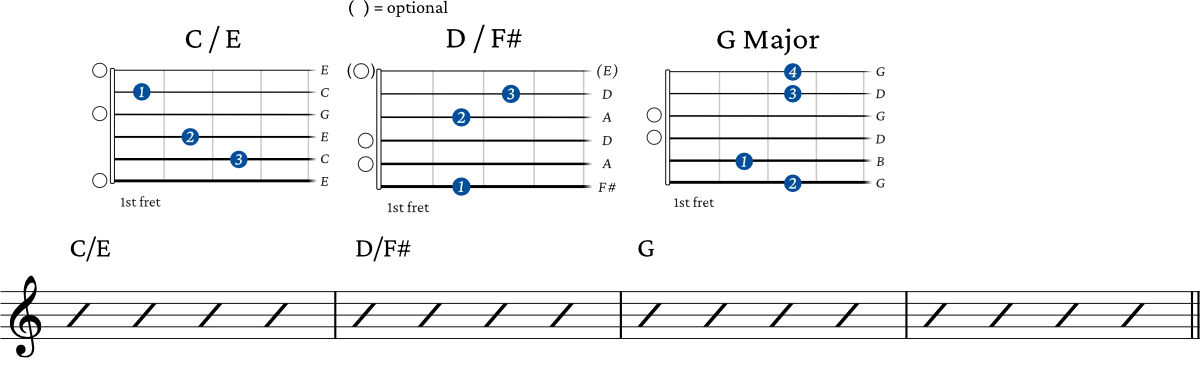
Now, the bass line smoothly moves up the G Major scale (E, F#, G). These are cool to use for variations throughout a song.
Example 1c
Instead of C minor 7 → G → C 7 → F, you can play this:
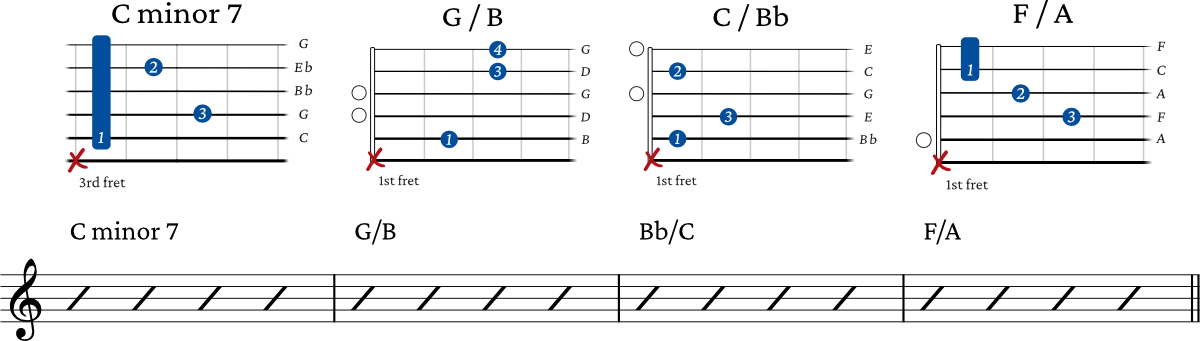
Now, the bass moves step-wise: C, B, Bb, A.
2. Using slash chords to simplify chord names
Use slash chords when you see a complicated chord name like G Major 7 (9) and want a simpler way to think about it. Helpful when sight-reading or arranging your own version of a song.
Example 2a
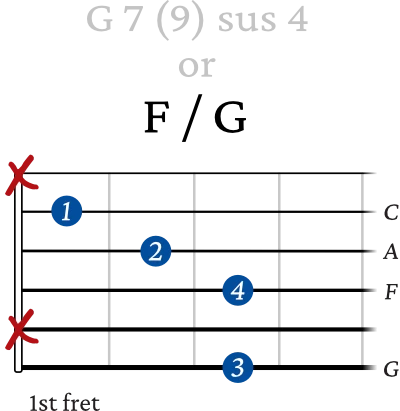
For example: F / G gives you the notes F, A, C, with G in the bass. Instead of writing a longer chord name like G7 (9) sus 4, you can simply write it as a slash chord. Here’s how that looks on the guitar:
Example 2b
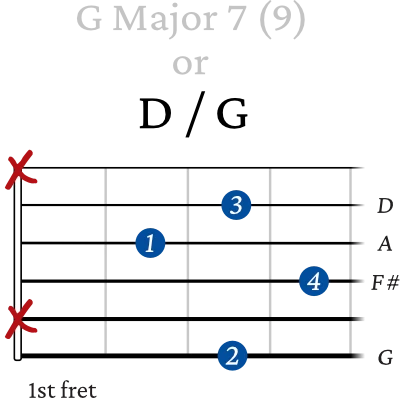
Instead of writing G Major 7 (9), you can write D/G. Both can represent similar note combinations, depending on the context.

Tip for slash chords
If you’re playing with a bassist or pianist, they’ll usually play the bass note. In that case, you can often just play the chord on the left side of the slash. Still, it’s worth learning both so you can use slash chords when playing on your own.
Included in Pro Membership ✨
Wrapping up
Slash chords are simply chords with a specific bass note.
You’ve seen how they can:
- Smooth out chord transitions
- Simplify complex chords
- Control the movement of the bass
Start by adding one into a progression you already know. You’ll hear the difference right away.
If you want to understand why these shapes work and how to move them across the fretboard, the next step is learning chord inversions.
📘 Get the free Practice Blueprint: Build better habits and make your progress more consistent. Download the free guide →