
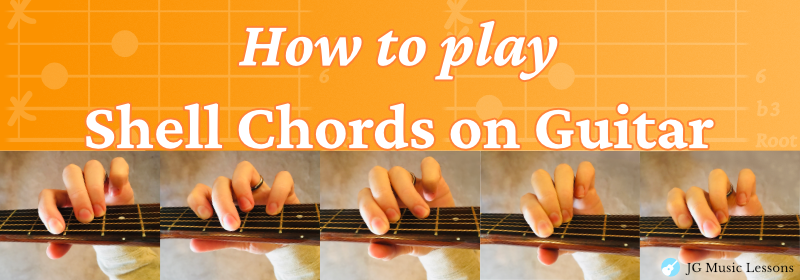
Shell chords are foundational shapes that every guitarist should know. These simplified three-note chords highlight the most essential tones in a chord: the root, third, and seventh, giving you a clearer understanding of how chords are built and function.
Because they focus only on the most important notes, shell chords serve as excellent building blocks for creating richer harmonic variations and expanding your chord vocabulary.
In this guide, we’ll break down the theory behind shell chords, explore their shapes on different string sets, and apply them in musical examples with tabs and audio.
Grab your guitar and let’s get started!
Skill Builders Roadmap Focus · View Roadmap →
Your goal is to understand why shell chords focus on the root, 3rd, and 7th, then get comfortable with Major 7, dominant 7, and minor 7 shell shapes starting from either the 6th or 5th string.
Shell Chords Overview
Shell chords are simplified three-note voicings that keep the notes most useful for defining a 7th chord: the root, 3rd, and 7th chord tones. The 5th is usually left out because the 3rd and 7th do more to define the chord quality.
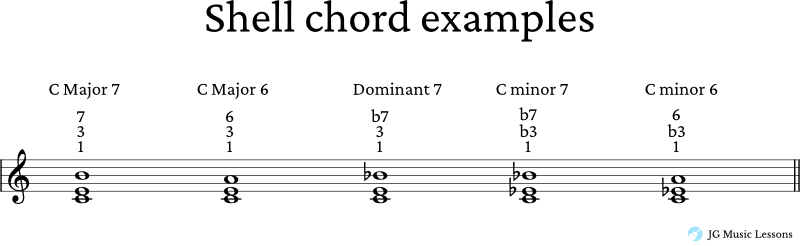
Here’s how different chord qualities are reduced to their essential shell chord tones:
- Major 7 chord – 1, 3, 7. For example: C Major 7: C, E, B
- Major 6 chord – 1, 3, 6. For example: C Major 6: C, E, A
- Dominant 7 chord – 1, 3, b7. For example: C 7: C, E, Bb
- Minor 7 chord – 1, b3, b7. For example: C minor 7: C, Eb, Bb
- Minor 6 chord – 1, b3, 6. For example: C minor 6: C, Eb, A
Try this: Focus first on the Major 7, dominant 7, and minor 7 formulas. The Major 6 and minor 6 shapes are useful variations you can come back to as you expand your chord vocabulary.
Guitar Shell Chord Shapes on the 6th string
We’ll start with shell chord shapes starting on the 6th string, and then cover the ones on the 5th string. Here is a quick overview of how to read the chord charts below.
How to read the guitar chord charts
For the following chord charts:
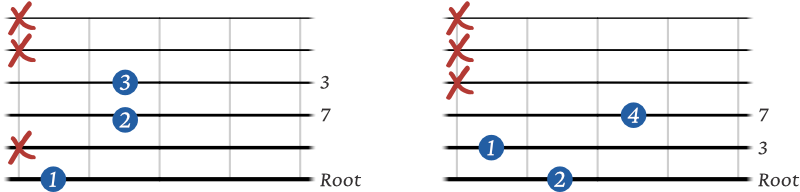
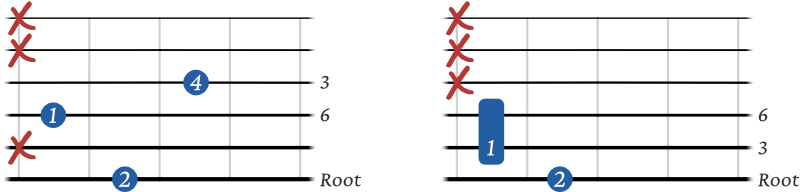
- The lowest horizontal line represents the thickest string (Low E). The top horizontal line represents the thinnest string (high E).
- The numbers inside the blue circles represent the suggested fingering to use on your fretting hand.
- The chord tones are written on the right of each string that is being played.
- Red X indicates not to play a specific string.
If needed, check out this guide on how to read guitar notation symbols.
Major 7 Shell Chords – 6th string
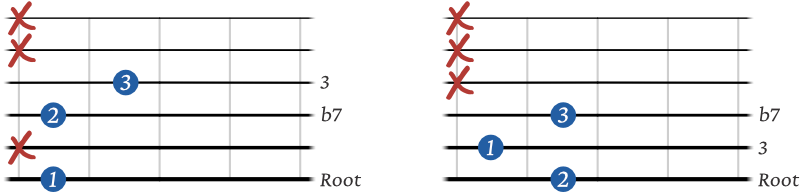
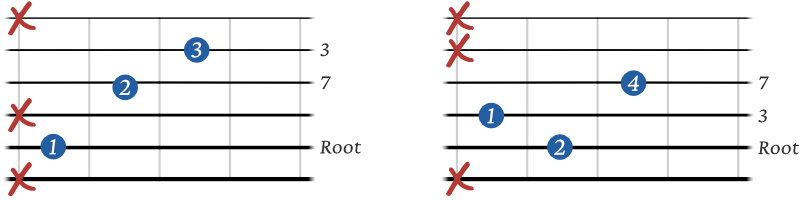
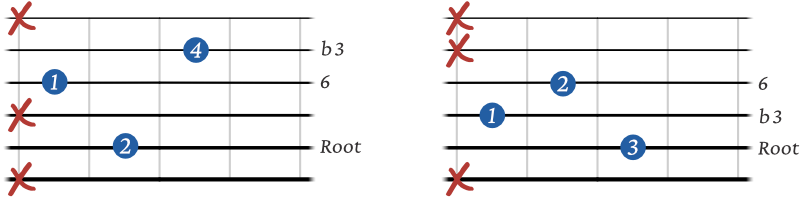
You will see two variations of shell chords for each chord quality. One way to order the chord tones is 1, 7, and 3 from the bottom to the top note. The second way is to play them 1, 3, and 7.
Major 6 Shell Chords – 6th string
Dominant 7 Shell Chords – 6th string
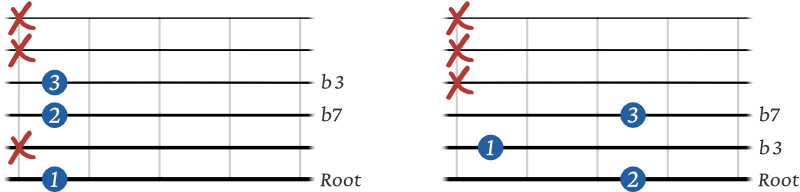
Minor 7 Shell Chords – 6th string
For the 2nd voicing, you can also play it with fingers 3, 1, and 4 from the bottom string up. Use whatever is most comfortable for you.
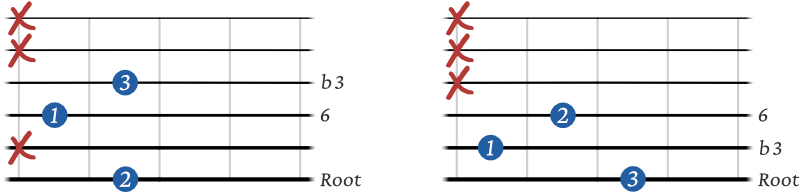
Minor 6 Shell Chords – 6th string
These shapes are technically the same for fully diminished chords which have a double flatted 7th chord tone (same as a 6th interval).
Guitar Shell Chords on the 5th string
Major 7 shell chords – 5th string
Major 6 Shell Chords – 5th string
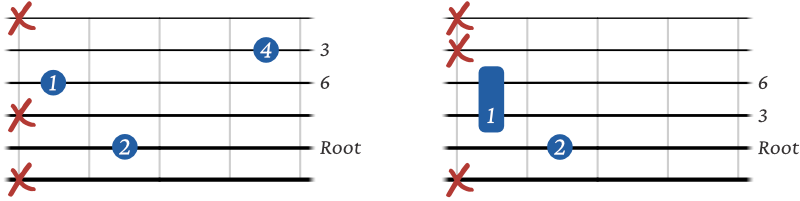
Dominant 7 Shell Chords – 5th string
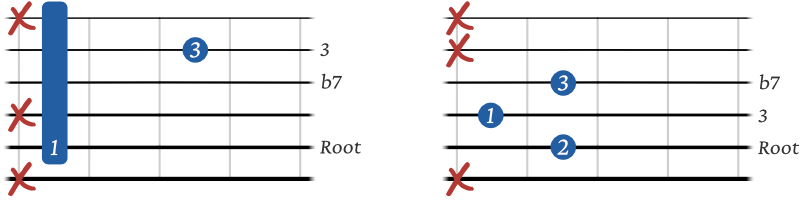
Minor 7 Shell Chords – 5th string
You can also play the 2nd voicing here with fingers 3, 1, and 4 from the bottom string up. Use whatever is most comfortable for you.
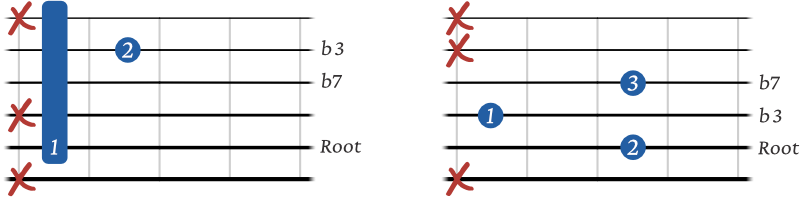
Minor 6 Shell Chords – 5th string
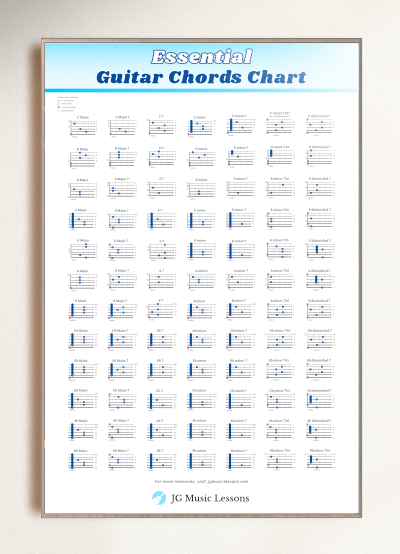
Put it into music: Once you can play a few shell shapes, choose one progression below and work through it slowly. Focus on finding the nearest shell shape for each chord rather than memorizing every example in this section.
Chord Progression Examples using Shell Chords
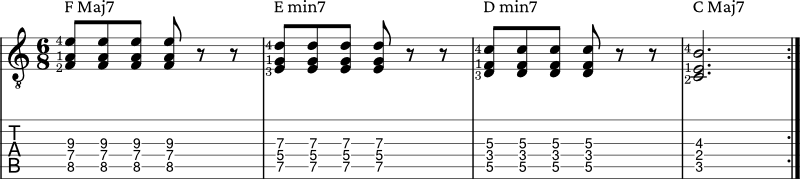
Here are some musical examples using shell chords including tabs and audio.
Shell Chord Progression Example 1
The first chord progression is in the key of C Major.
Shell Chord Progression Example 2
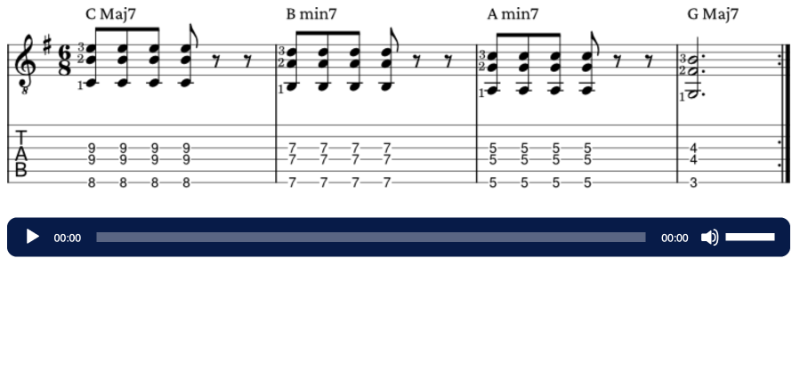
Here is the same chord progression as the previous except we shift the chords to the key of G Major.
Included with Pro
Take this lesson a little further.
This bonus section is included with Pro Membership. Pro also gives you the full Guitar Roadmap to keep your learning in order, plus direct access to me when something isn’t clicking.
Already a member?
Log in →
Included in Pro Membership ✨
Wrapping up
Shell chords give you a compact way to hear and play the notes that define a chord. Instead of using every note from a larger chord shape, they focus on the root, 3rd, and 7th while usually leaving out the 5th.
Start with Major 7, dominant 7, and minor 7 shell shapes on one root-string set. Notice how changing the 3rd or 7th changes the chord quality, then use those shapes in one of the progressions above.
As these shapes become familiar, practice them in different keys and explore the 5th-string versions, Major 6 and minor 6 voicings, and other variations. Shell chords also give you a useful foundation for understanding fuller 7th chords and more extended jazz chord shapes later on.
Before continuing
You’re ready to continue when you can explain why a shell chord usually keeps the root, 3rd, and 7th, play Major 7, dominant 7, and minor 7 shell shapes from one root-string set, and use at least two of those shapes in a short chord progression.
Next: Continue in the Skill Builders Roadmap to see where this skill fits and what to practice next.
📘 Get the free Practice Blueprint: Build better habits and make your progress more consistent. Download the free guide →