
The difference between a “correct” chord and a “beautiful” chord is often just one note. If your progressions sound fine but not rich, 7th chords are the fastest upgrade.
They show up everywhere, blues, jazz, folk, R&B, pop. And once you know a few core shapes, you can instantly make basic progressions sound more musical.
In this lesson you’ll learn:
- The 3 most useful 7th chord types: Major 7, Dominant 7, and Minor 7
- Easy guitar shapes for each chord
- Movable shapes so you can play 7th chords in any key
- Progression examples with audio, so you can hear how they work in real music
Grab your guitar and let’s get started.
Skill Builders Roadmap Focus · View Roadmap →
Your goal is to understand the formulas for Major 7, dominant 7, and minor 7 chords, then get one useful shape for each under your fingers. After that, practice moving one 7th-chord shape to another root note. Use the remaining chord charts and progressions as references as you build fluency.
What is a 7th chord?
A 7th chord is a chord with four chord tones instead of three.
- Triad chords use: 1, 3, 5
- 7th chords add the 7th so you get: 1, 3, 5, 7
That extra note is what gives 7th chords their smoother, deeper sound.
7th chord theory (simple formulas)
Major 7 chord formula
Major 7 chord uses: 1, 3, 5, 7
Here are some Major 7 chord examples and what notes they include:
- C Major 7 has the notes C, E, G, and B.
- E Major 7 has the notes E, G#, B, and D#.
- G Major 7 has the notes G, B, D, and F#.
(See the distance between each of the chord tones in steps below.)
Quick note on intervals:
A half step is one fret away from a starting note.
A whole step is two frets away from a starting note.

As a side note, another chord that is closely related to the Major 7 is the Major 6 chord which has the chord tones 1, 3, 5, and 6. See this other lesson on how to play Major 6 chords on guitar.
Dominant 7 chord formula
Dominant 7 chord is like Major 7, but the 7 is lowered: 1, 3, 5, b7
The little ‘b’ represents that a note is flattened or lowered by a half step.

Dominant chords are written with just a 7 next to the root note such as G 7, B 7, or D 7.
Here are Dominant 7 chord examples and what notes they include:
- C 7 has the notes C, E, G, and Bb.
- E 7 has the notes E, G#, B, and D.
- G 7 has the notes G, B, D, and F.
Minor 7 chord formula
Minor 7 chord lowers the 3rd and the 7th a half step below like this: 1, b3, 5, b7

Minor 7 examples:
- C minor 7 has the notes C, Eb, G, and Bb.
- E minor 7 has the notes E, G, B, and D.
- G minor 7 has the notes G, Bb, D, and F.
Comparison exercise: Choose one root note and build all three chord qualities from it. For example, compare C Major 7, C 7, and C minor 7. Notice which chord tones change: Major 7 uses 1, 3, 5, 7; dominant 7 lowers the 7th; minor 7 lowers both the 3rd and 7th.
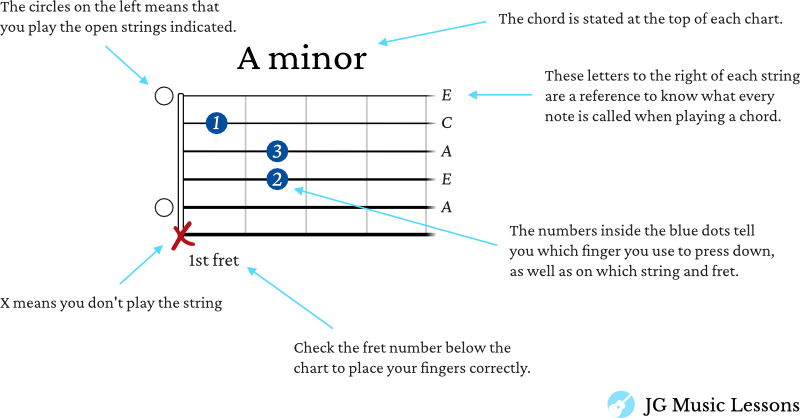
How to read the guitar chord charts
For the charts below:
- The lowest horizontal line represents the thickest string (Low E). The top horizontal line represents the thinnest string (high E).
- The vertical lines represent the frets on the guitar (thin metal lines on your guitar fretboard)
- The numbers inside the circles tell you what fingers to use to press down on your fretting hand (see the fingering chart in the following section)
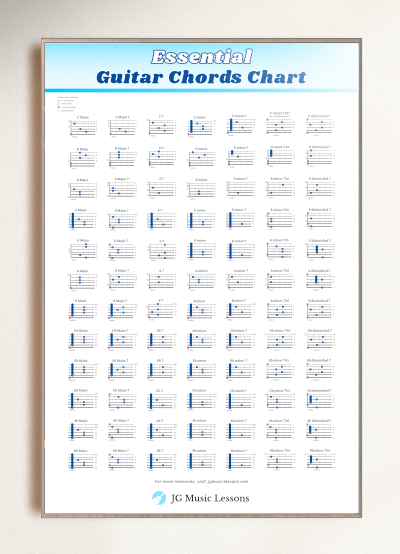
Take a look at the image below to better understand the chord charts in this lesson.
Use the chord charts below as a reference: You don’t need to memorize every Major 7, dominant 7, and minor 7 chord here. Start with one comfortable example of each chord quality and make sure you can hear and explain the difference between them.
Major 7th chords
Now, let’s start playing them. These are just some common ways to play each chord. Use the link under each chart to see alternate options.
C Major 7
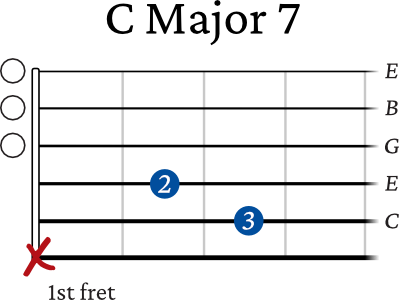
7 ways to play a C Major 7 chord on guitar
D Major 7
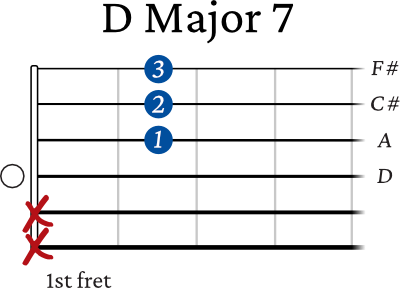
8 ways to play a D Major 7 chord on guitar
E Major 7
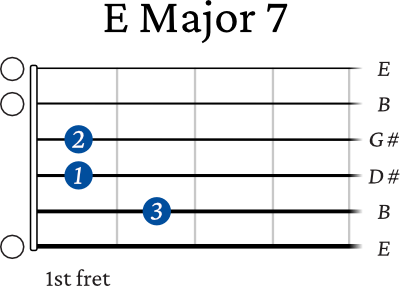
8 ways to play an E Major 7 chord on guitar
F Major 7
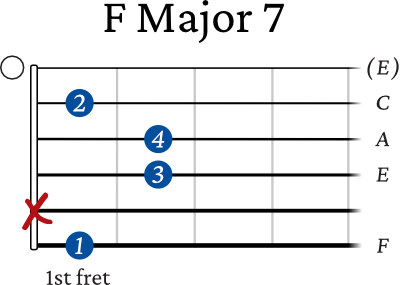
8 ways to play an F Major 7 chord on guitar
G Major 7
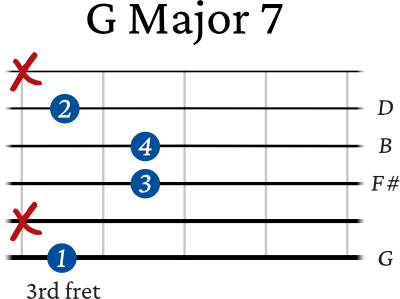
8 ways to play a G Major 7 chord on guitar
A Major 7
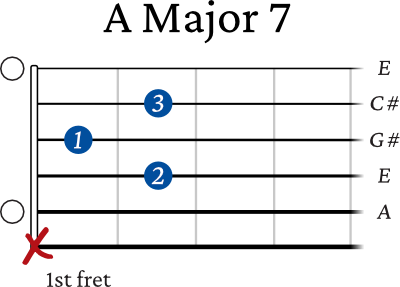
8 ways to play an A Major 7 chord on guitar
B Major 7
Note that the note on the 1st string in parenthesis is optional which means you don’t necessarily have to barre this chord if you aren’t able to yet.
If needed, see this lesson on how to get better at barre chords.
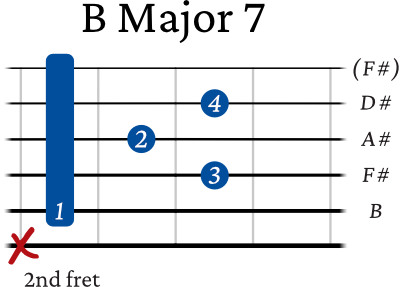
7 ways to play a B Major 7 chord on guitar
Dominant 7th chords
C 7
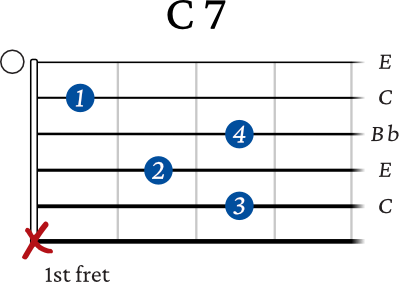
7 ways to play a C 7 chord on guitar
D 7
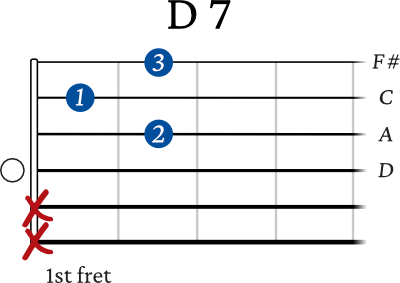
7 ways to play a D 7 chord on guitar
E 7
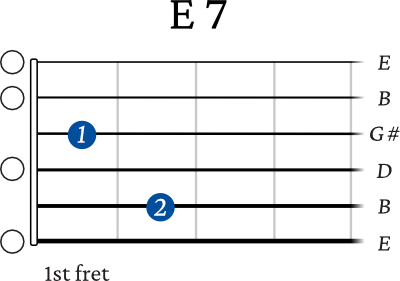
11 ways to play an E 7 chord on guitar
F 7
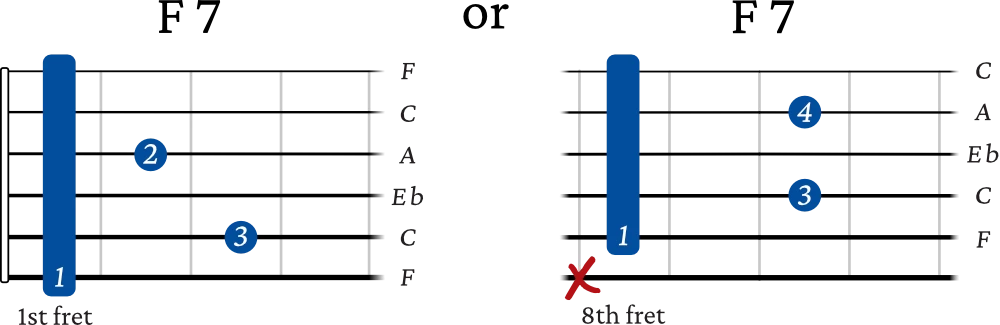
10 ways to play an F 7 chord on guitar
G 7
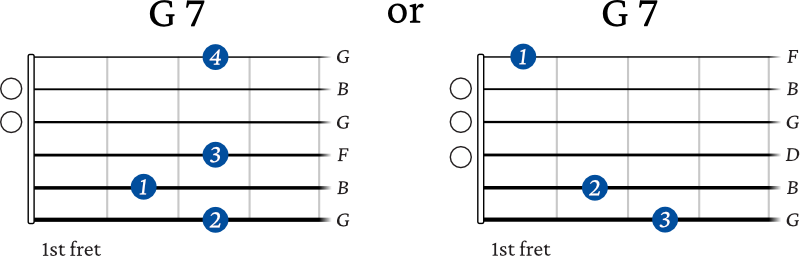
10 ways to play a G 7 chord on guitar
A 7
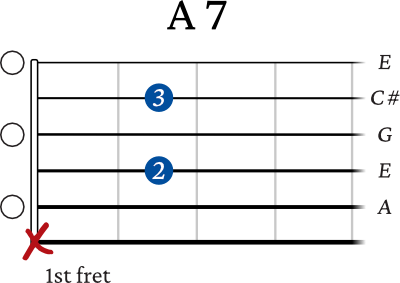
9 ways to play an A 7 chord on guitar
B 7
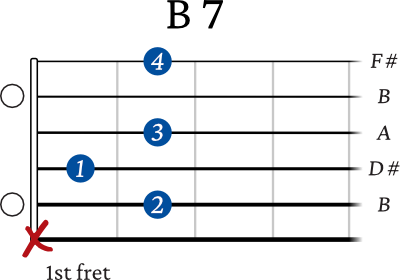
7 ways to play a B 7 chord on guitar
Minor 7th chords
C minor 7
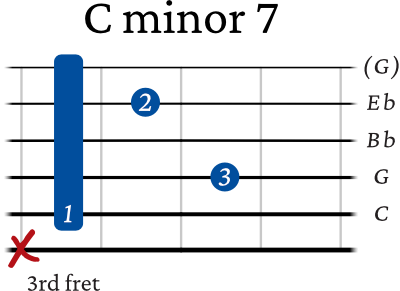
8 ways to play a C minor 7 chord on guitar
D minor 7
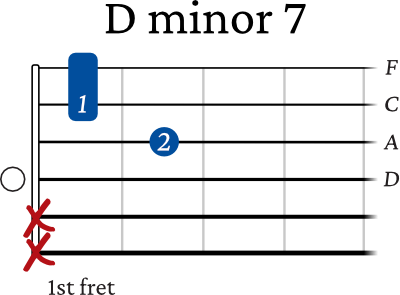
8 ways to play a D minor 7 chord on guitar
E minor 7
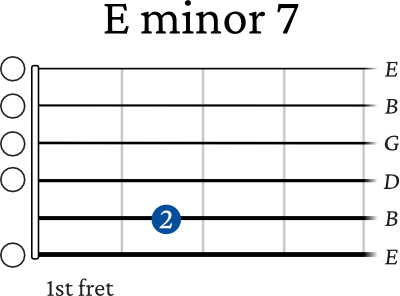
11 ways to play an E minor 7 chord on guitar
F minor 7
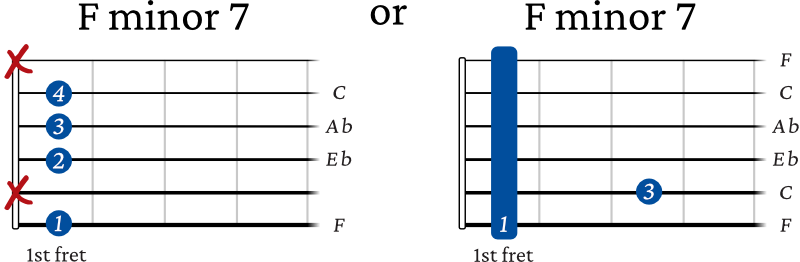
8 ways to play an F minor 7 chord on guitar
G minor 7
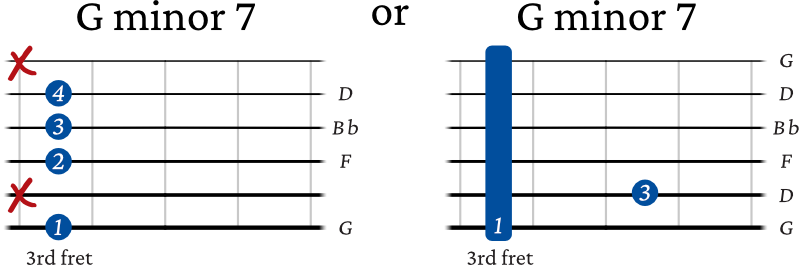
8 ways to play a G minor 7 chord on guitar
A minor 7
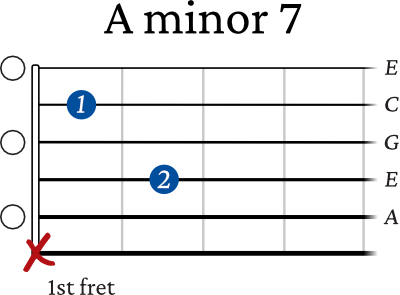
11 ways to play an A minor 7 chord on guitar
B minor 7
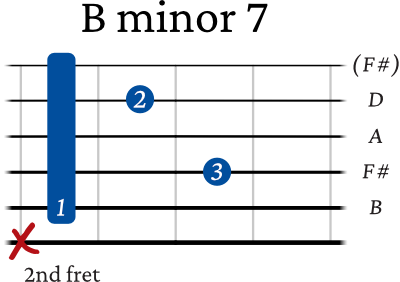
8 ways to play a B minor 7 chord on guitar
Movable 7th chords
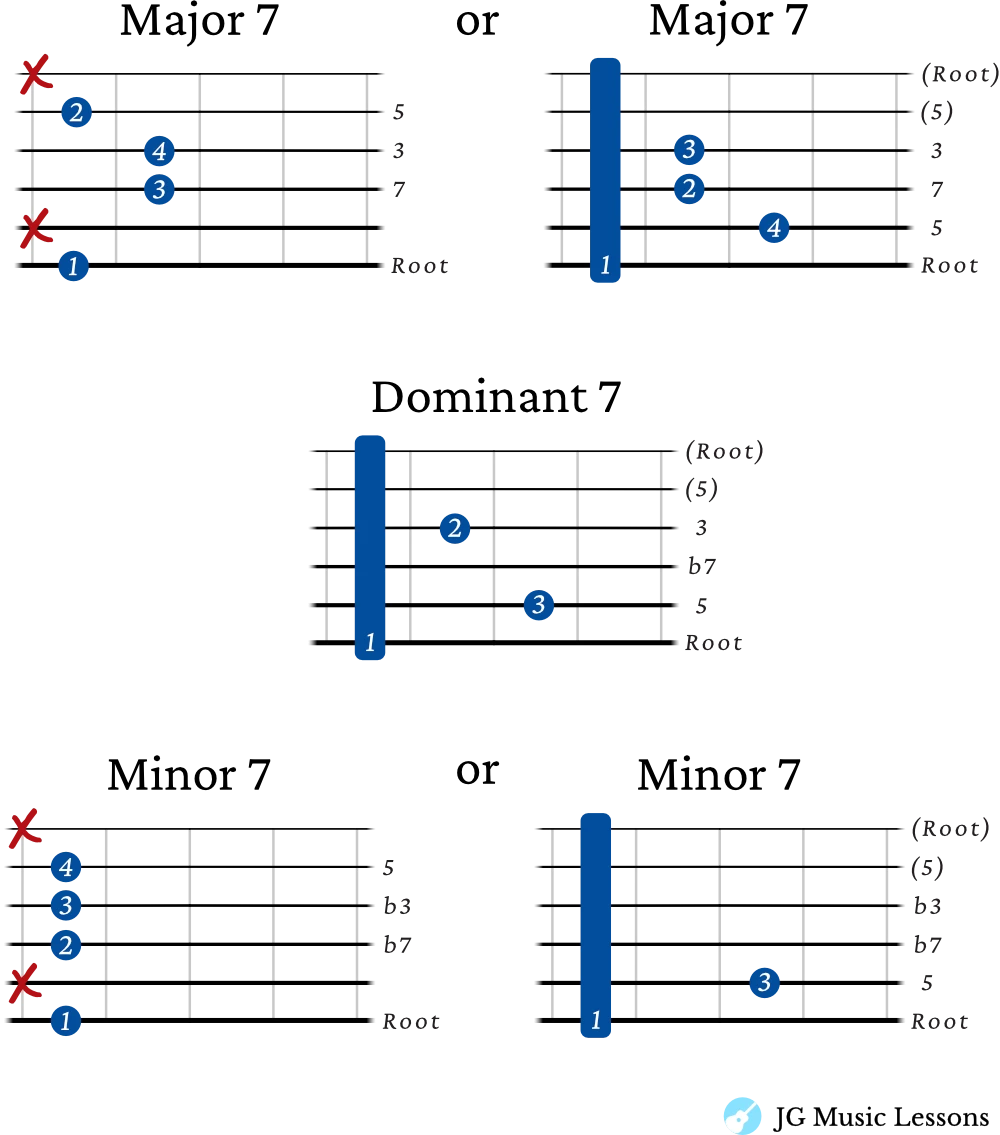
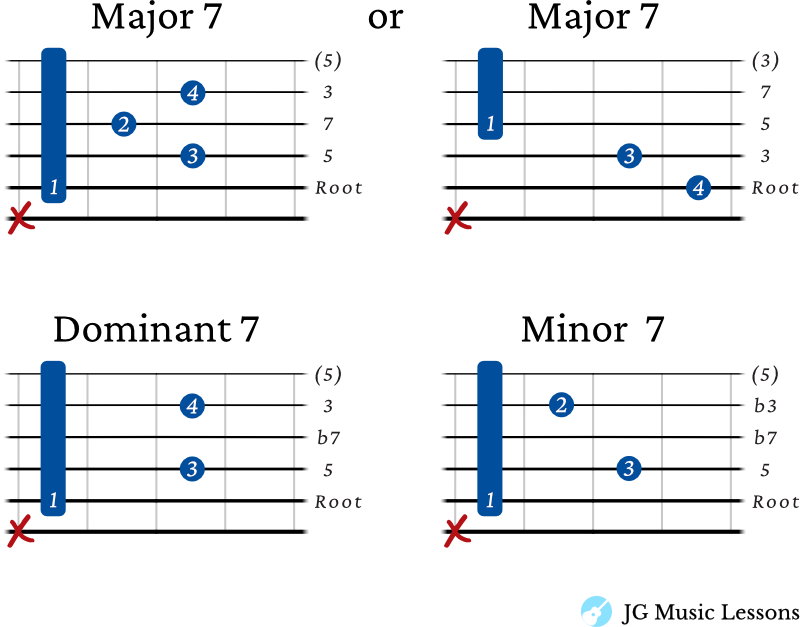
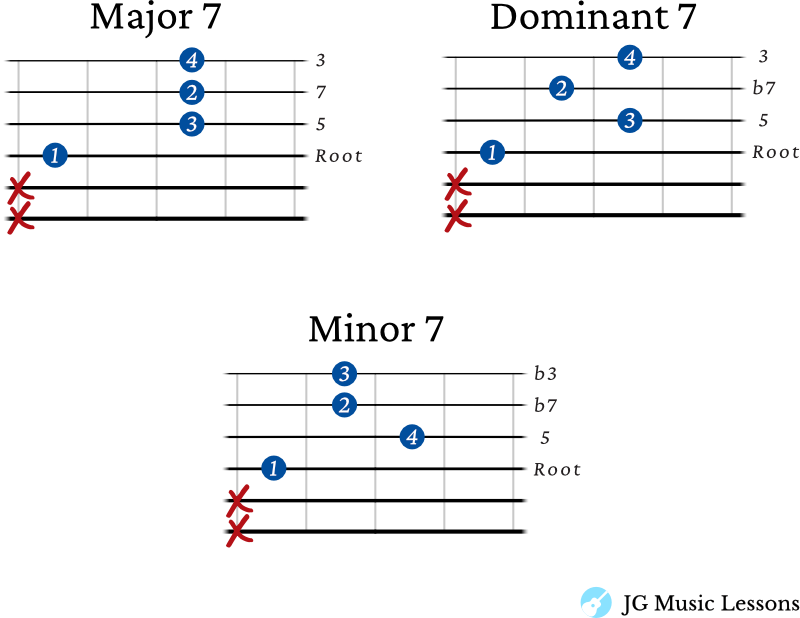
Movable shapes let you take one 7th-chord shape and use it with different root notes across the fretboard. Start with one movable shape that feels comfortable, identify its root note, and move it to at least one other fret.
The 6th-, 5th-, and 4th-string examples below give you several options. You don’t need to memorize every movable shape before continuing.
How to implement:
- In these shapes, the lowest note is your root
- Slide the entire shape to a new fret to change keys
- If you need help finding root notes, learn the notes on the fretboard first
Movable 7th chords starting on the 6th string
The numbers on the right show the chord tones. Notes in parentheses are optional.
Example: If your root is A, place the lowest note on the 6th string, 5th fret.
Movable 7th chords starting on the 5th string
Example: If your root is D, place the lowest note on the 5th string, 5th fret.
Movable 7th chords starting on the 4th string
Example: If your root is G, place the lowest note on the 4th string, 5th fret.
Chords progression examples using 7th chords
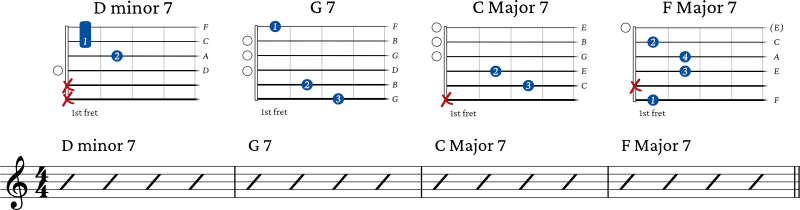
Choose one progression below and play through it slowly. Use any rhythm or strumming pattern you like. Focus on clean chord changes and listening for how the different 7th-chord qualities sound in context.
7th chord progression example 1
Click the chords with links to learn other ways of playing that chord. Progression 1 chords are D minor 7, G 7, C Major 7, and F Major 7.
7th chord progression example 2
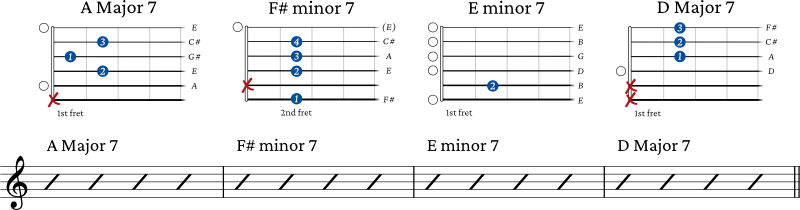
Progression 2 chords are A Major 7, F# minor 7, E minor 7, and D Major 7.
7th chord progression example 3
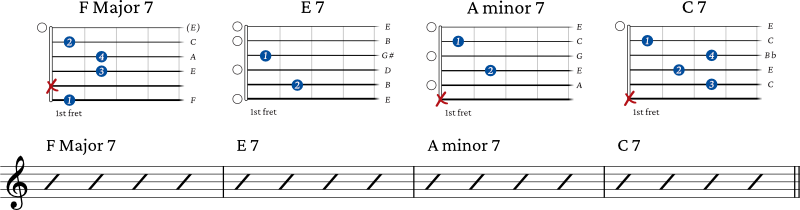
Progression 3 chords are F Major 7, E 7, A minor 7, and C 7.
Want more progression examples you can play along with? Get the bonus progressions below inside Pro Membership. ✨
Included with Pro
Take this lesson a little further.
This bonus section is included with Pro Membership. Pro also gives you the full Guitar Roadmap to keep your learning in order, plus direct access to me when something isn’t clicking.
Already a member?
Log in →
Other 7th chords: Diminished chords
Two useful 7th chord types we didn’t cover here that have their unique sound and function:
• Minor 7 b5 (half diminished)
Included in Pro Membership ✨
Wrapping up
Major 7, dominant 7, and minor 7 chords all build on the triads you’ve already learned by adding a 7th. The important difference is which chord tones change: Major 7 uses 1, 3, 5, 7, dominant 7 uses 1, 3, 5, b7, and minor 7 uses 1, b3, 5, b7.
Start with one useful shape for each chord quality, then practice moving one of those shapes to another root note. You can also try replacing a basic chord with a 7th chord and listen to how it changes the progression.
If you want to explore these sounds more deeply, you can practice the individual chord tones through Major 7 arpeggios, dominant 7 arpeggios, and minor 7 arpeggios.
As these chords become more familiar, you’ll have more options when you learn songs or create your own music. These three chord qualities also give you a foundation for learning extended chords on guitar later on.
Before continuing
You’re ready to continue when you can explain that a minor 7 b5 chord uses 1, b3, b5, and b7, show how it differs from a minor 7 chord, and move one minor 7 b5 shape to at least two different root notes.
Next: Continue in the Skill Builders Roadmap to see where this skill fits and what to practice next.
📘 Get the free Practice Blueprint: Build better habits and make your progress more consistent. Download the free guide →