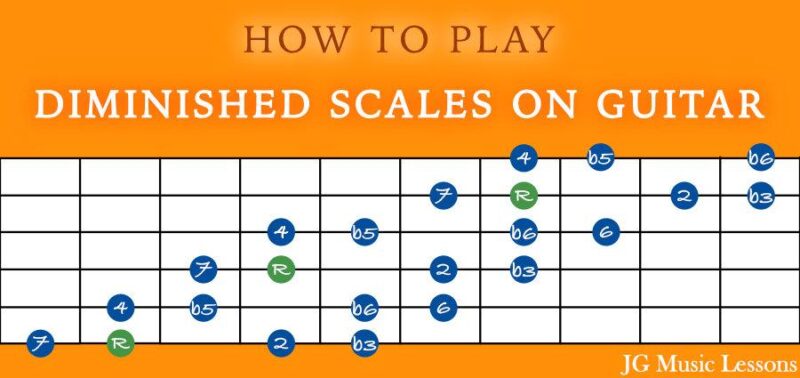
The diminished scale is a repeating eight-note scale that can create tension over diminished and dominant 7 chords.
There are two versions to learn: whole-half diminished and half-whole diminished. In this lesson, you’ll learn how each one is built, play them on the fretboard, and hear where each sound can be used.
Mastery Roadmap Focus · View Roadmap →
Learn one whole-half and one half-whole diminished shape. Hear the difference between them, then practice whole-half over a diminished 7 chord and half-whole over a dominant 7 chord.
Diminished scales music theory
Diminished scales contain eight notes and are built from an alternating pattern of whole and half steps. There are two versions: whole-half diminished and half-whole diminished.
Let’s look at the scale formulas with some examples below.
Whole half diminished scale
The whole-half diminished scale alternates a whole step and a half step throughout the scale. Its pattern is whole, half, whole, half, whole, half, whole, half.
For example, C whole-half diminished contains C, D, Eb, F, Gb, Ab, A, and B.

Whole half diminished scale chart
Here are some examples of whole half diminished scales below.
| Whole half diminished scale | 1 | 2 | b3 | 4 | b5 | b6 | 6 | 7 |
|---|---|---|---|---|---|---|---|---|
| C whole half diminished | C | D | Eb | F | Gb | Ab | A | B |
| C# whole half diminished | C# | D# | E | F# | G | A | A# | C |
| D whole half diminished | D | E | F | G | Ab | Bb | B | C# |
Half whole diminished scale
The half-whole diminished scale starts with a half step and then alternates whole and half steps. Its pattern is half, whole, half, whole, half, whole, half, whole.
For example, C half-whole diminished contains C, Db, Eb, E, F#, G, A, and Bb.

Play C whole-half diminished and C half-whole diminished slowly. Listen to the first two notes of each scale. Whole-half begins with a whole step, while half-whole begins with a half step. Use that starting interval to help you recognize which version you’re playing.
Half whole diminished scale chart
Here are some examples of half whole diminished scales below.
| Half whole diminished scale | 1 | b2 | b3 | 3 | #4 | 5 | 6 | b7 |
|---|---|---|---|---|---|---|---|---|
| C half whole diminished | C | Db | Eb | E | F# | G | A | Bb |
| C# half whole diminished | C# | D | E | F | G | G# | A# | B |
| D half whole diminished | D | Eb | F | F# | G# | A | B | C |
Related diminished scales
The diminished scale is symmetrical because its whole- and half-step pattern repeats. This means the same collection of notes repeats when you move the root by a minor 3rd, or three frets.
For example, C, Eb, Gb, and A whole-half diminished all contain the same notes, starting from different places.
- C# whole-half diminished shares the same notes as E, G, and Bb whole-half diminished.
- D whole-half diminished shares the same notes as F, Ab, and B whole-half diminished.
Because this pattern repeats every three frets, learning the diminished scale from C, C#, and D gives you the three different note collections needed to cover all 12 roots.
Whole half diminished scale shapes on guitar
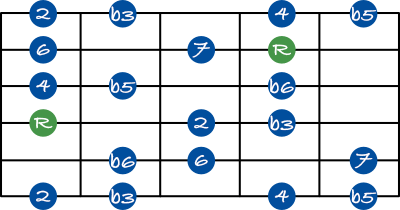
In this section, we’ll be covering the four whole half diminished scale shapes in several positions of the guitar fretboard.
How to read the scale charts
For the charts below:
- The lowest horizontal line represents the thickest string (Low E). The top horizontal line represents the thinnest string (high E).
- The green circles represent the root note of the diminished scale and the blue notes are every scale note in between.
- The numbers inside the circles represent the suggested fingering to use on your fretting hand.
If needed, check out how to read guitar notation symbols.
The following shapes show different areas of the fretboard for the whole-half diminished scale. Start with one shape and keep track of the root notes before adding another position.
W/H diminished shape 1
On the 1st shape, I include a suggested fingering that you can use for all the other shapes. The root notes are highlighted in green.
For diminished scales, the guitar scale shapes look exactly the same starting every minor 3rd interval or every 3 frets across one string. Even though the shapes look the same, it’s helpful to keep in mind where your root notes are.
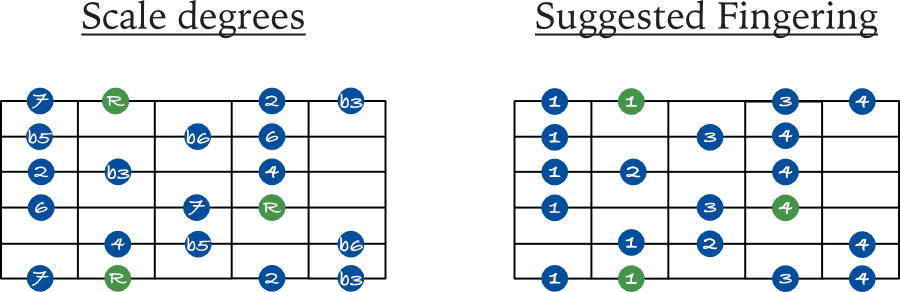
Play one whole-half diminished shape slowly and identify the root, b3, b5, and 6. Then move the same shape up three frets and notice how the same note collection repeats from a different root.
W/H diminished shape 2
W/H diminished shape 3
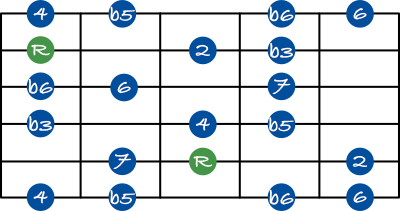
W/H diminished shape 4
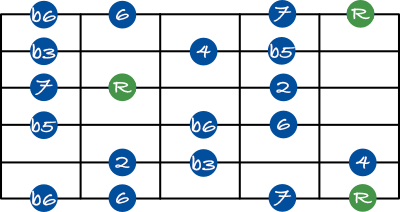
Half whole diminished scale shapes
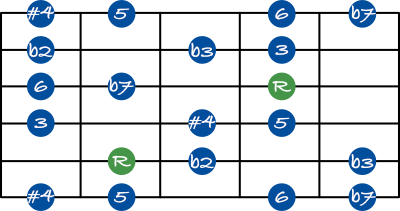
The half-whole diminished scale uses the same alternating interval idea, but begins with a half step. Start with one shape and compare its sound and scale degrees with the whole-half version.
H/W diminished shape 1
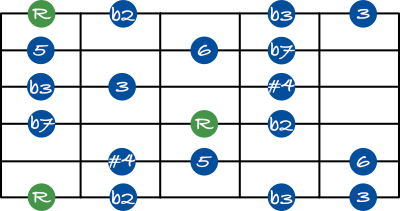
Play one half-whole diminished shape and identify the root, 3rd, 5th, and b7. Listen for how those notes outline a dominant 7 chord inside the scale.
H/W diminished shape 2
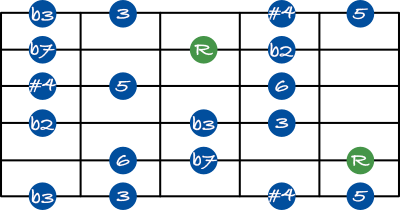
H/W diminished shape 3
H/W diminished shape 4
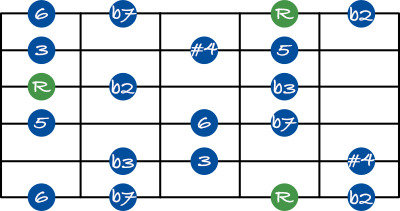
Once one shape of each diminished scale feels comfortable, use the remaining positions to expand the same sounds into other areas of the fretboard.
Connecting diminished scale shapes
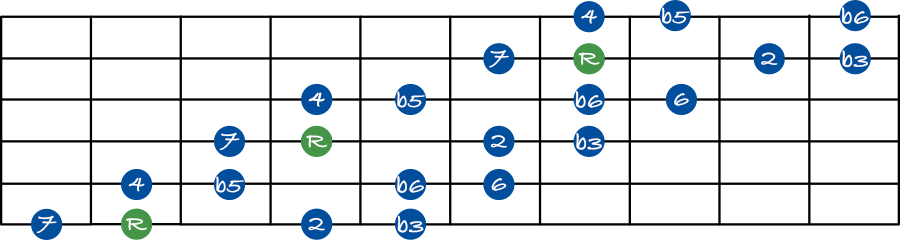
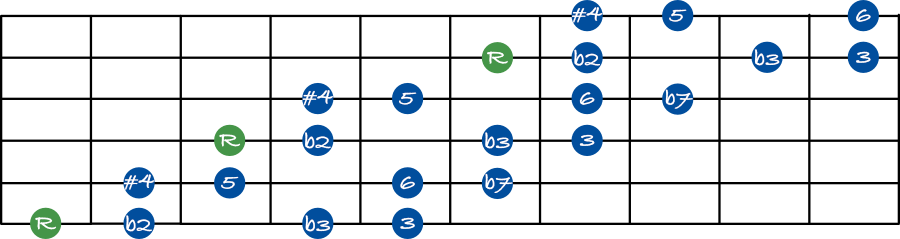
The diagrams below show how neighboring diminished scale positions overlap. Use them when you’re ready to move beyond a single position.
H/W diminished scale connecting shape
W/H diminished scale connecting shape
Diminished scale application examples
A simple way to choose between the two diminished scales is:
- Whole-half diminished: use it over a diminished 7 chord from the same root.
- Half-whole diminished: use it over a dominant 7 chord from the same root when you want the extra tension contained in the scale.
For a quick overview, diminished chords have the chord tones 1, b3, and b5 while diminished 7 chords have the chord tones 1, b3, b5, and 6. If needed, check out this lesson on how to play diminished chords on guitar.
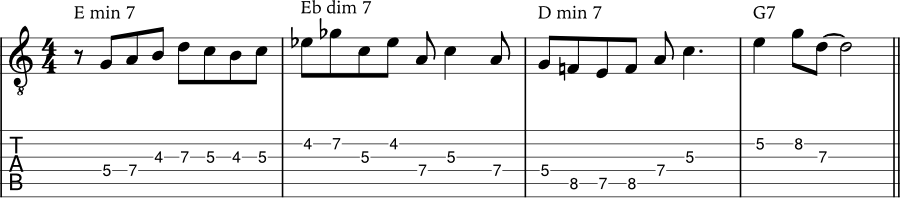
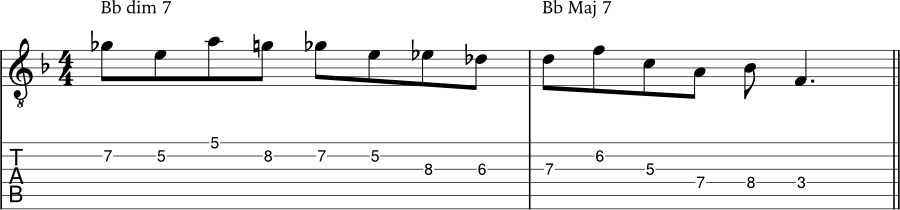
Examples 1 through 3 show the whole-half diminished sound over diminished harmony. Start with Example 1, then use the others as additional ideas.
Example 1
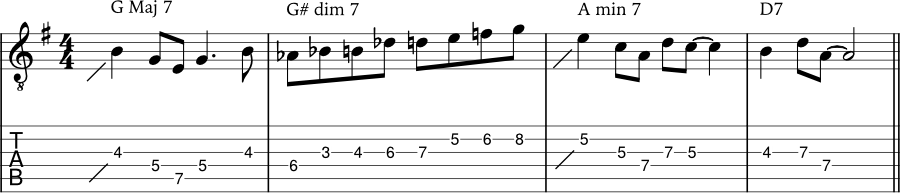
Play Example 1 and listen for how the scale fits the diminished chord. Then change the rhythm or note order to create a short idea of your own from the same shape.
Example 2
Example 3
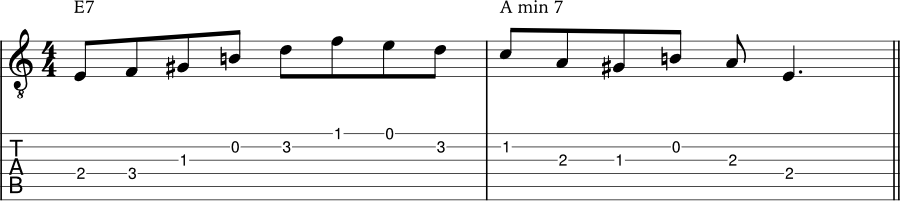
Examples 4 through 6 show the half-whole diminished sound over dominant harmony. Start with Example 4 and listen to how the added tension changes the dominant 7 sound.
Example 4
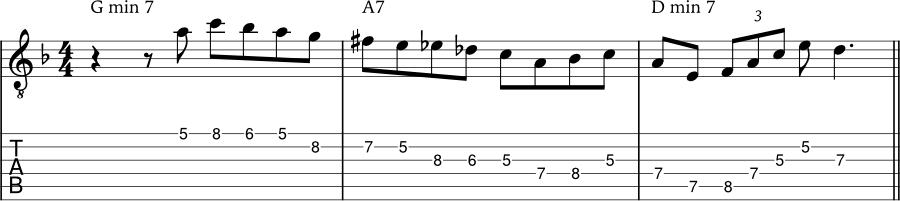
Play Example 4 over the dominant 7 chord. Then create a short phrase of your own using the same half-whole diminished shape.
Example 5
Example 6
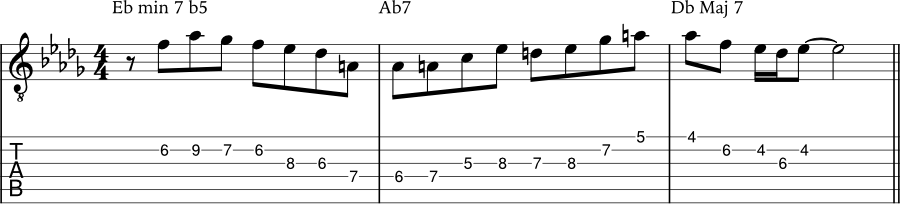
To learn other ways to play over a dominant chord, check out these jazz and blues licks over a dominant chord.
Choose one diminished 7 chord and one dominant 7 chord. Play whole-half diminished over the diminished 7 chord, then half-whole diminished over the dominant 7 chord. Create one short phrase for each and listen to how the two scale sounds fit their different chord qualities.
Wrapping up
Diminished scales contain eight notes built from alternating whole and half steps. Whole-half begins with a whole step, while half-whole begins with a half step.
Start with one shape of each. Connect whole-half diminished with diminished 7 chords and half-whole diminished with dominant 7 chords, then listen to how each scale creates tension in a different harmonic setting.
From there, the additional shapes, symmetry across the fretboard, and application examples give you more ways to expand these sounds.
Before continuing
You’re ready to continue when you can tell the difference between whole-half and half-whole diminished scales, play one shape of each, and use whole-half over a diminished 7 chord and half-whole over a dominant 7 chord.
Next: Continue in the Mastery Roadmap to keep developing advanced scale sounds and their musical application.
📘 Get the free Practice Blueprint: Build better habits and make your progress more consistent. Download the free guide →