

An augmented chord starts with a Major triad and raises the 5th by one half step. That small change gives the chord a tense sound that can create smooth movement into the next chord.
In this lesson, you’ll learn the augmented chord formula, common shapes on guitar, and several ways to use the sound inside chord progressions.
Mastery Roadmap Focus · View Roadmap →
Start with one Major chord and raise its 5th by one fret to create an augmented sound. Compare the two chords, then use the augmented chord inside a short progression and listen for where the raised note wants to move next.
What are augmented chords?
An augmented triad contains the chord tones 1, 3, and #5. You can think of it as a Major chord with the 5th raised by one half step.
For example, C Major contains C, E, and G. Raise G to G# and you get C augmented: C, E, and G#.
You may see these chords written in different ways such as using a plus sign (+), “aug” or #5. For example:
- C+
- Caug
- C(#5)
See the formula for Augmented chords in whole and half steps below.
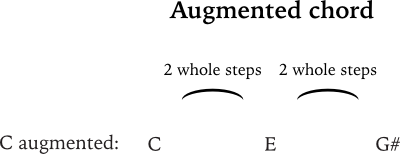
Play C Major, then C augmented. Listen specifically to the G moving up to G#. Repeat the comparison with one other Major chord you know.
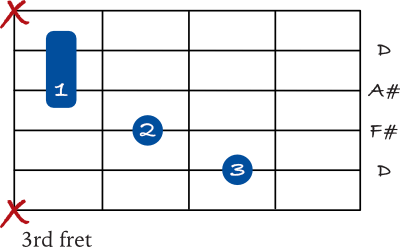
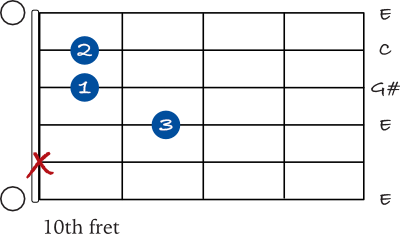
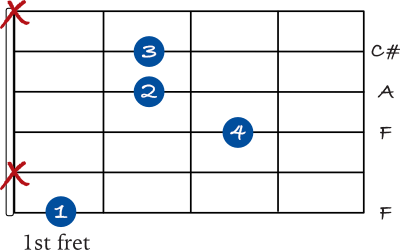
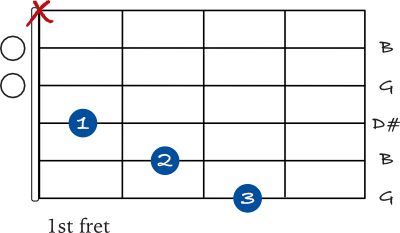
The diagrams below show several movable augmented shapes. Start with one shape that feels comfortable and move it to a few different roots before exploring the rest.
Augmented chord shapes
How to read the chord charts
For the charts below:
- The top horizontal line of the chord chart represents the high E string and the bottom horizontal line represents the low E string.
- The vertical lines separate each fret.
- The numbers in the blue dots tell you which fingers to use on the fretting hand.
- The letters on the right of the charts tell you what chord tones you are playing on each string.
- Circles on the left represent open strings.
- Red X means to avoid that string.
You can check this link for more on how to read guitar notation symbols.
Augmented chord shapes on the 6th string
Note that these chords may sound strange on their own, but you will see how they stand out within the context of a chord progression in the examples at the end.
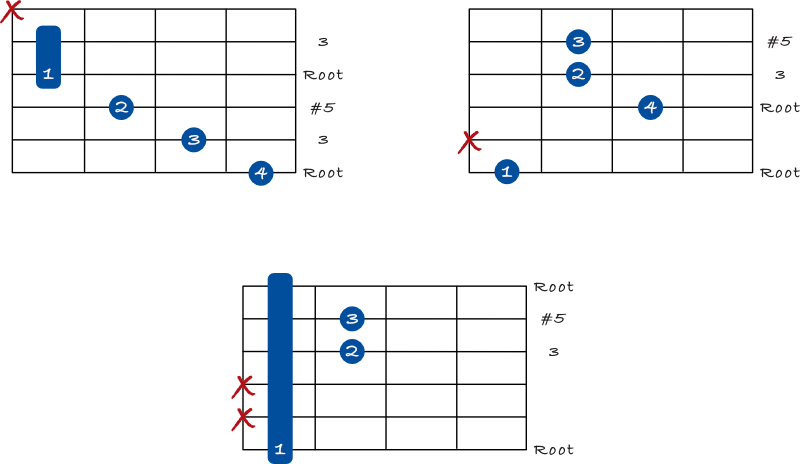
Choose one augmented shape and move it to three different roots. For each chord, name the root and play the Major version first, then the augmented version so you can hear the raised 5th.
Augmented chord shapes on the 5th string
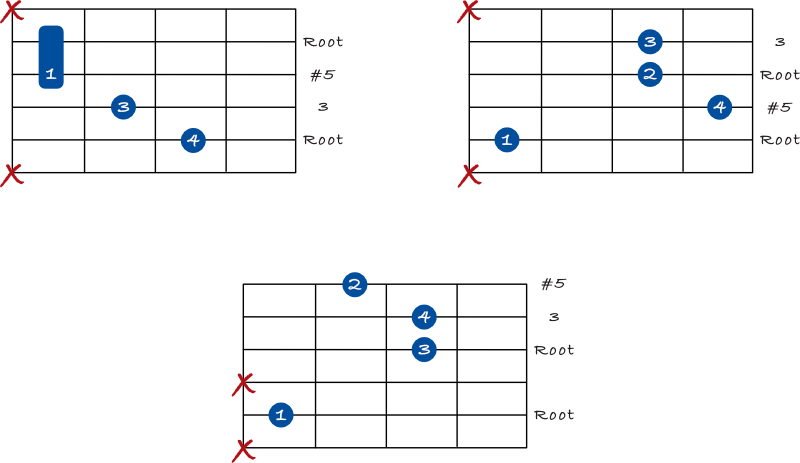
Augmented chord examples
The examples below show the same augmented sound from several root notes. Use them when you need a specific chord rather than treating the entire section as one exercise.
C augmented chord
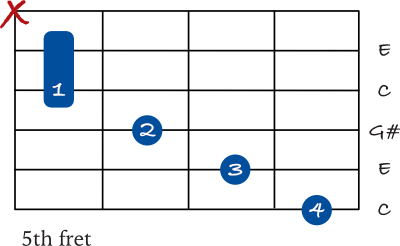
D augmented chord
E augmented chord
F augmented chord
G augmented chord
A augmented chord
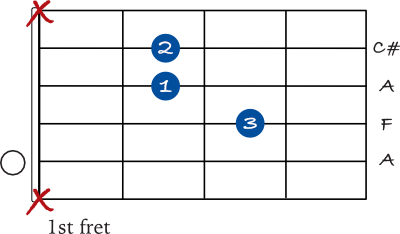
B augmented chord
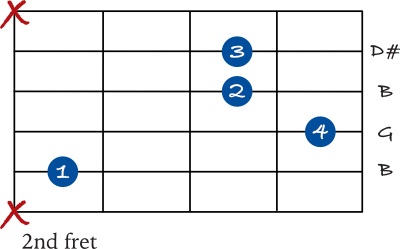
Augmented Major 7 chords
Once the augmented triad is comfortable, you can extend the sound by adding a Major 7th. An augmented Major 7 chord contains 1, 3, #5, and 7.

Now, let’s look at some of the shapes you can use starting on different strings.
Augmented Major 7 chord shapes on the 6th string
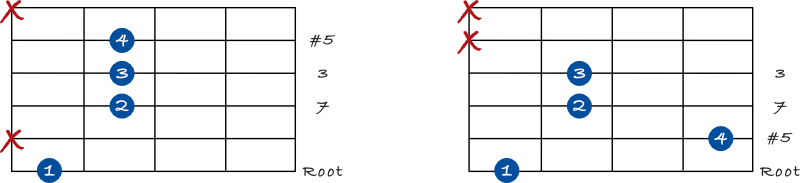
Augmented Major 7 chord shapes on the 5th string
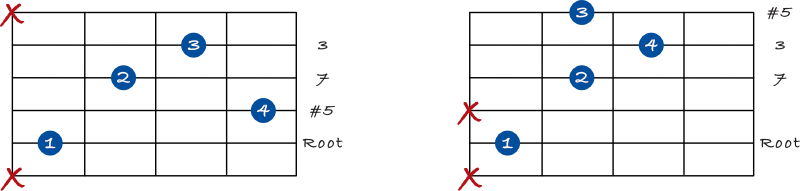
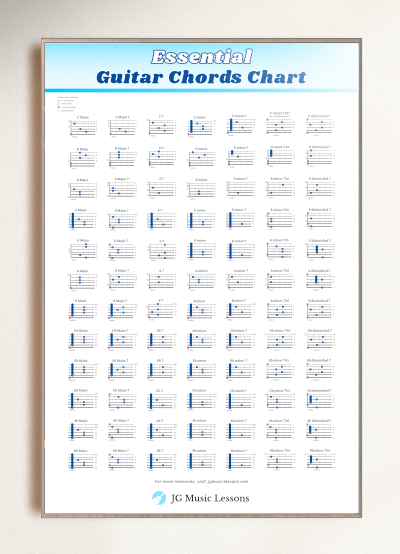
Chord progressions using augmented chords
Augmented chords become much easier to understand when you follow the movement of the raised 5th into the next chord. Listen for that moving note as you play the examples below.
Example 1
The chords are C Major, C augmented, C 6, C 7, and F Major 7. You can click on the chords with links to learn other ways of playing that chord.
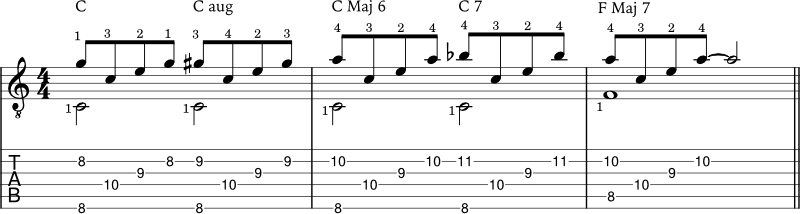
Play C Major → C augmented → C 6 slowly. Listen to the upper movement G → G# → A. Then repeat the progression and try to hear that three-note line without looking at the chord names.
After you can hear the basic Major → augmented movement, use the remaining examples to explore the same sound in different harmonic settings and voicings.
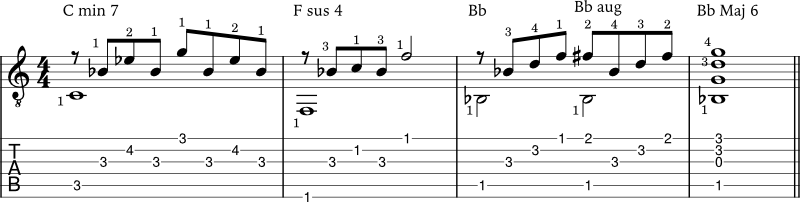
Example 2
The chords are C minor 7, F sus 4, Bb Major, Bb augmented, and Bb Major 6.
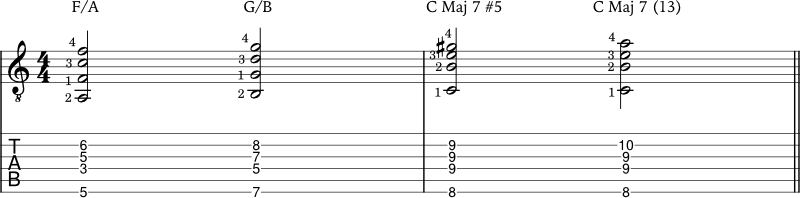
Example 3
This example uses the slash chords F/A and G/B then goes to a C Major 7 #5 and C Major 7(13). See this guide to learn jazz guitar chords.
Example 4
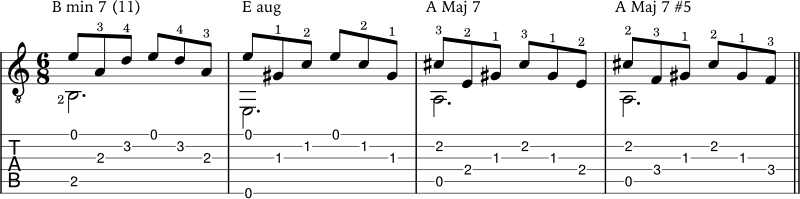
For this example, we’re using the augmented chord over the 5 chord (E aug) in the key of A Major. The chords are B minor 7(11), E augmented, A Major 7, A Major 7 #5.
Example 5
For this last example, we also use the augmented chord on the 5 chord (D aug) in the key of G Major. The chords are D Major, D augmented, and G Major 7.

Compare D Major → G Major with D augmented → G Major. Listen to how raising the 5th of D changes the tension before the G chord.
Bonus: The symmetrical augmented shape
An augmented triad is built from equal Major 3rd intervals. Because of that symmetry, the same three pitches can be heard from three different roots.
For example, C augmented, E augmented, and G# augmented share the same pitch collection, with a different note treated as the root.
That means you can technically derive all 12 augmented chords from only four distinct augmented chord groups: C, Db, D, and Eb augmented.
Play one augmented shape, move the entire shape up four frets, and play it again. Listen for how the same augmented pitch collection repeats in another inversion.
Wrapping up
Augmented chords take a familiar Major sound and create tension by raising the 5th.
Start by hearing the difference between a Major and augmented chord, then use that raised note inside a progression such as C → Caug → C6 or D → Daug → G.
From there, the additional shapes, augmented Major 7 voicings, and symmetrical relationships in this lesson give you more ways to use the sound across the fretboard.
Before continuing
You’re ready to continue when you can turn a Major chord into an augmented chord by raising the 5th, use that sound inside a short progression, and hear how the raised note creates movement into the chord that follows.
Next: Continue in the Mastery Roadmap to keep developing advanced chord voicings and harmony.
📘 Get the free Practice Blueprint: Build better habits and make your progress more consistent.
Download the free guide →