
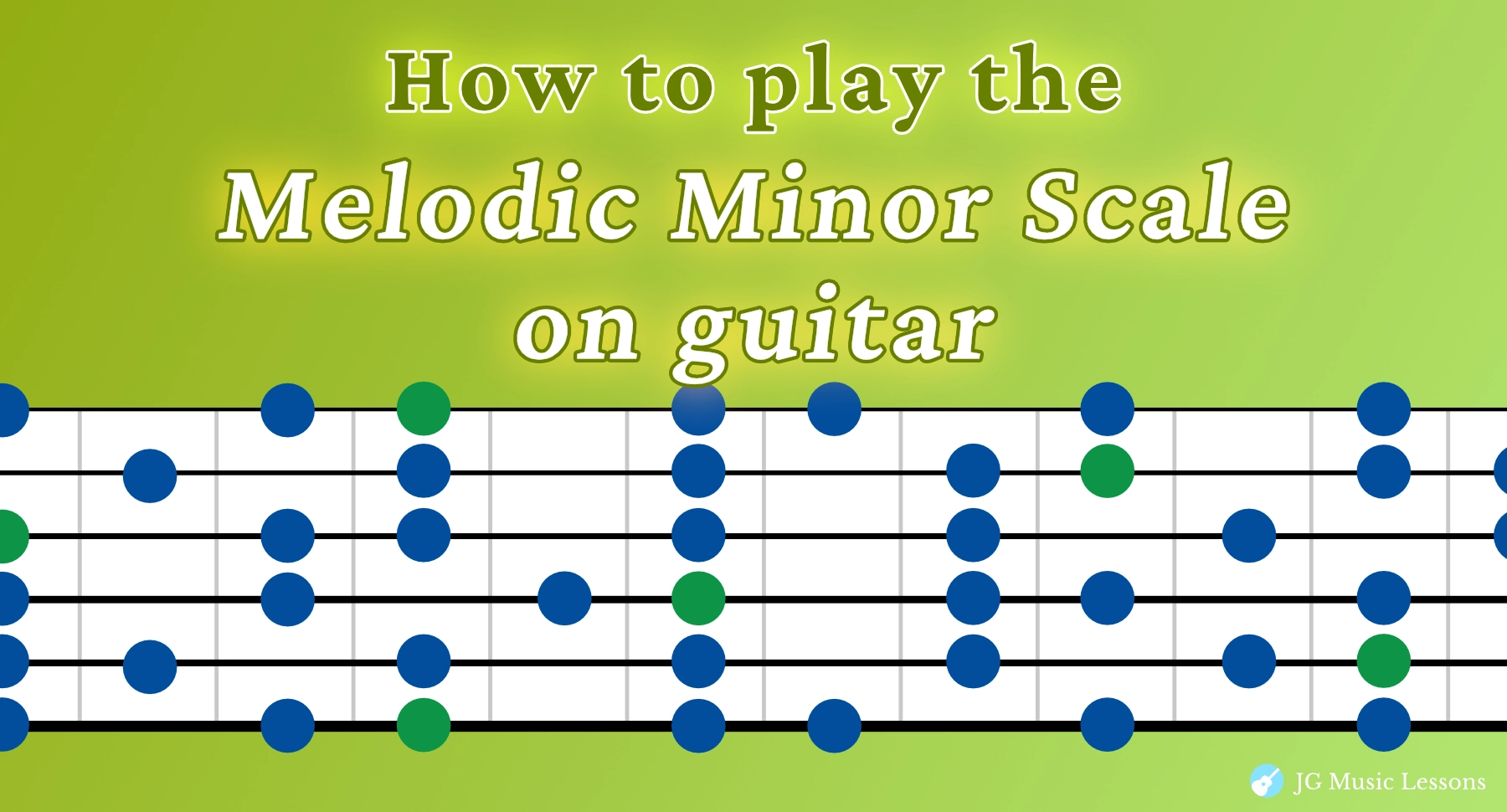
The melodic minor scale has a minor sound with a natural 6th and 7th, giving it a different color from the natural minor scale.
If you already know a Major scale shape, melodic minor is easy to relate to it: keep the same notes and lower the 3rd by one fret.
In this lesson, you’ll learn the formula, fretboard shapes, and several ways to practice and apply the scale musically.
Mastery Roadmap Focus · View Roadmap →
Start with one Major scale shape you already know and lower the 3rd to create melodic minor. Compare the two sounds, then use the melodic minor shape to create a short musical phrase.
Melodic minor scale formula
In this lesson, we’re using the form of melodic minor commonly used in jazz and modern improvisation, where the same notes are played ascending and descending.
The melodic minor scale has the formula 1, 2, b3, 4, 5, 6, 7.
An easy way to build it is to start with a Major scale and lower the 3rd by one half step.
For example:
- C Major: C, D, E, F, G, A, B
- C melodic minor: C, D, Eb, F, G, A, B
Compare that with the natural minor scale:
- Natural minor: 1, 2, b3, 4, 5, b6, b7
- Melodic minor: 1, 2, b3, 4, 5, 6, 7
The 6th and 7th are the notes that distinguish melodic minor from natural minor.
Melodic minor scale formula
The whole and half step formula for the melodic minor scale is whole, half, whole, whole, whole, whole, half. Here is an example applied to the C melodic minor scale:

Play C Major, then C melodic minor. Listen specifically to E changing to Eb while the other six notes stay the same. Then compare C natural minor with C melodic minor and listen to the change in the 6th and 7th.
Melodic minor scale in all keys
Using the formula we looked at, here is a chart of the melodic minor scale in all keys.
| Melodic minor scale | 1 | 2 | b3 | 4 | 5 | 6 | 7 |
|---|---|---|---|---|---|---|---|
| C melodic minor scale | C | D | Eb | F | G | A | B |
| D melodic minor scale | D | E | F | G | A | B | C# |
| E melodic minor scale | E | F# | G | A | B | C# | D# |
| F melodic minor scale | F | G | Ab | Bb | C | D | E |
| G melodic minor scale | G | A | Bb | C | D | E | F# |
| A melodic minor scale | A | B | C | D | E | F# | G# |
| B melodic minor scale | B | C# | D | E | F# | G# | A# |
| F# melodic minor scale | F# | G# | A | B | C# | D# | F |
| Db melodic minor scale | Db | Eb | E | Gb | Ab | Bb | C |
| Eb melodic minor scale | Eb | F | Gb | Ab | Bb | C | D |
| Gb melodic minor scale | Gb | Ab | A | B | Db | Eb | F |
| Ab melodic minor scale | Ab | Bb | B | Db | Eb | F | G |
| Bb melodic minor scale | Bb | C | Db | Eb | F | G | A |
Use this chart as a reference when you want to build melodic minor from a specific root. In a progression, make sure the natural 6th and 7th fit the harmony you’re playing over.
Melodic minor scale application examples
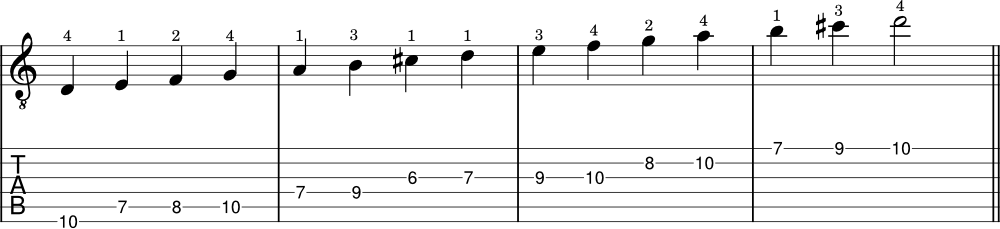
The examples below show the scale in several keys. Start with one key and listen closely to the sound before moving the same formula to another root.
C melodic minor scale
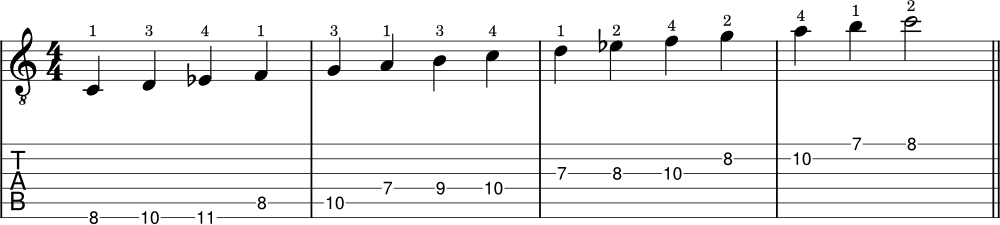
Play C melodic minor slowly up and down. As you play, identify the root, b3, 6, and 7. These notes will help you hear and recognize the character of the scale.
D melodic minor scale
E melodic minor scale
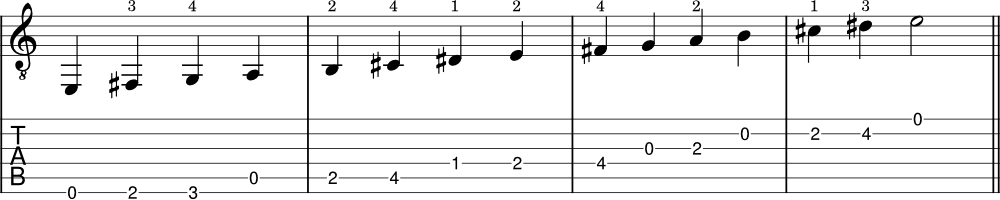
G melodic minor scale
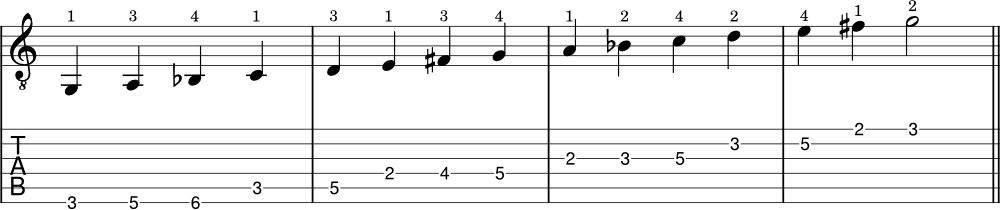
Now let’s see how this scale connects across the entire fretboard with the 5 essential shapes.
5 Melodic minor scale shapes on the guitar
We can break down the melodic minor scale into 5 different sections of the guitar fretboard. You can play these shapes starting on any root note.
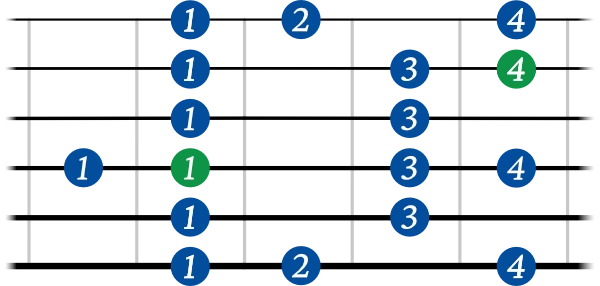
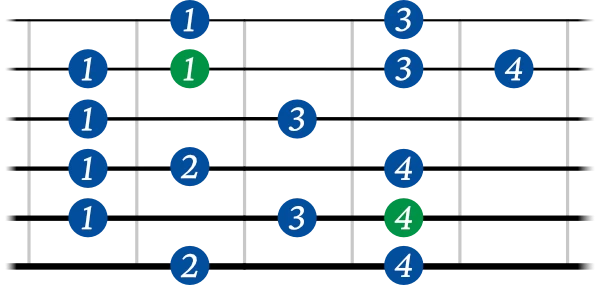
How to read the scale charts
For the charts below:
- The lowest horizontal line represents the thickest string (Low E). The top horizontal line represents the thinnest string (high E).
- The green circles represent the root note of the melodic minor scale and the blue notes are every scale note in between.
- The numbers inside the circles represent the suggested fingering to use on your fretting hand.
If needed, check out how to read guitar notation symbols.
The five shapes below show how melodic minor covers the fretboard. Start with one shape that feels comfortable and use the others later to expand into nearby areas of the neck.
Shape 1
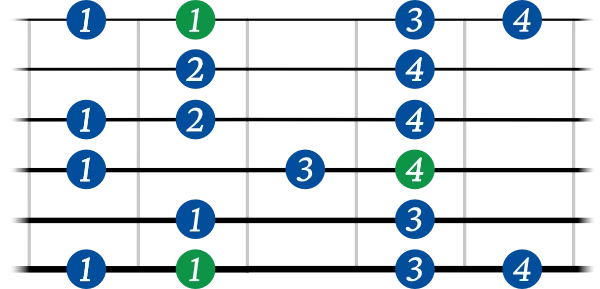
Choose one root and play Shape 1 slowly. Find the root notes and the b3 inside the shape, then play it again while listening for the melodic minor sound rather than only watching the fingering.
Shape 2
Shape 3
Shape 4
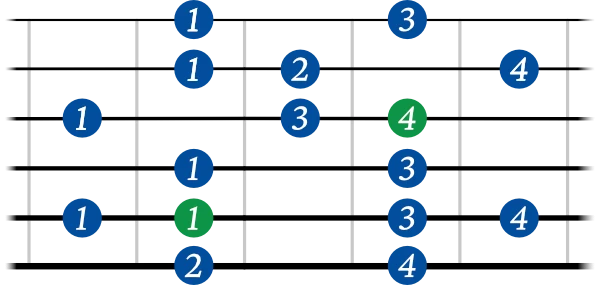
Shape 5
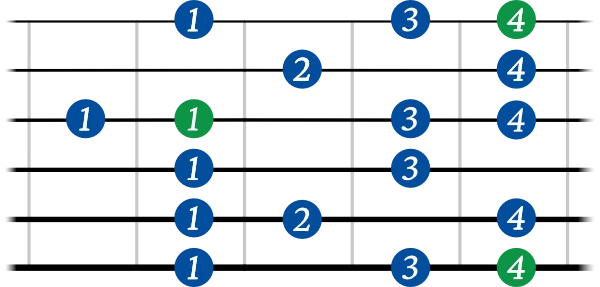
Once your first shape feels comfortable, choose one neighboring shape and find the notes where the two positions overlap.
Create a short line that begins in your first shape and crosses into the neighboring shape without stopping.
Note: When playing these shapes with open strings, adjust your fingerings as needed. For example, if a shape uses fingering 1, 3, 4 on one string, you can play open, 1, 3 instead. Once you move to fretted positions, the original shapes return.
Melodic Minor scale shapes connected on guitar
The diagram below shows how the five positions connect across the fretboard. Use it as a map when you want to move beyond the one or two shapes you’re currently practicing.
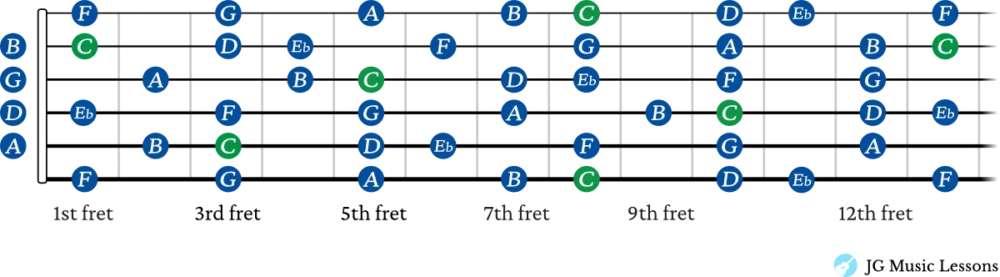
Use the Major scale as your template
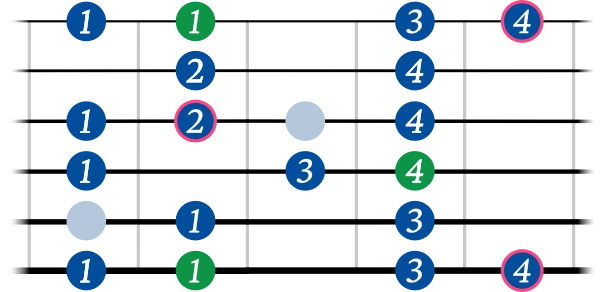
A useful way to learn melodic minor is to start with a Major scale shape you already know and lower the 3rd.
This helps you see the relationship between the two scales instead of treating melodic minor as a completely separate fretboard system.
The charts below show where the 3rd changes inside each Major scale position.
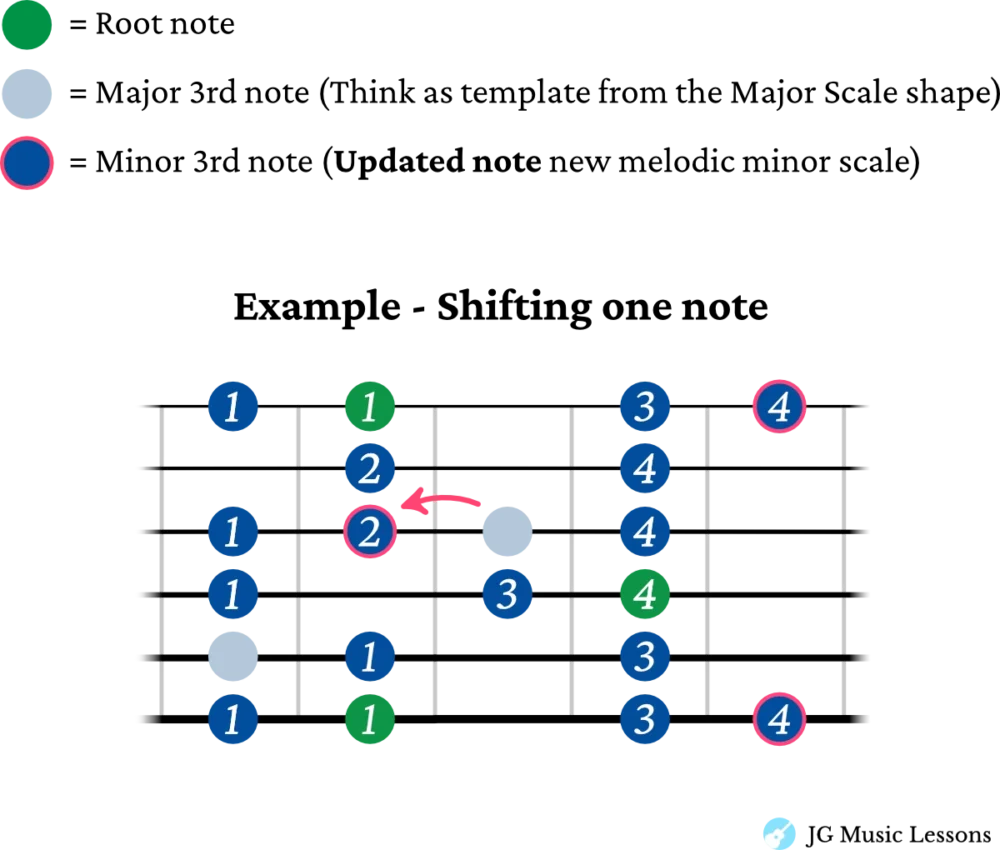
Shape 1
Included with Pro
Take this lesson a little further.
This bonus section is included with Pro Membership. Pro also gives you the full Guitar Roadmap to keep your learning in order, plus direct access to me when something isn’t clicking.
Already a member?
Log in →
Melodic minor scale patterns
The patterns below give you different ways to move through the scale after the basic shape is comfortable. Choose one pattern first and use the others as additional practice options.
4 note ascending scale pattern
The following pattern ascends four consecutive notes in the scale and repeats on the next scale degree.
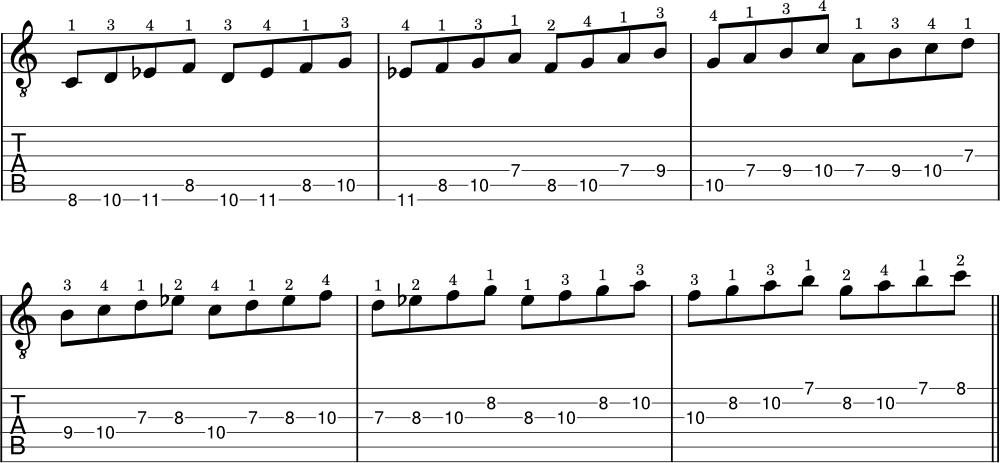
Apply one pattern to the melodic minor shape you’re learning. Then stop using the pattern and turn a small part of it into your own short phrase.
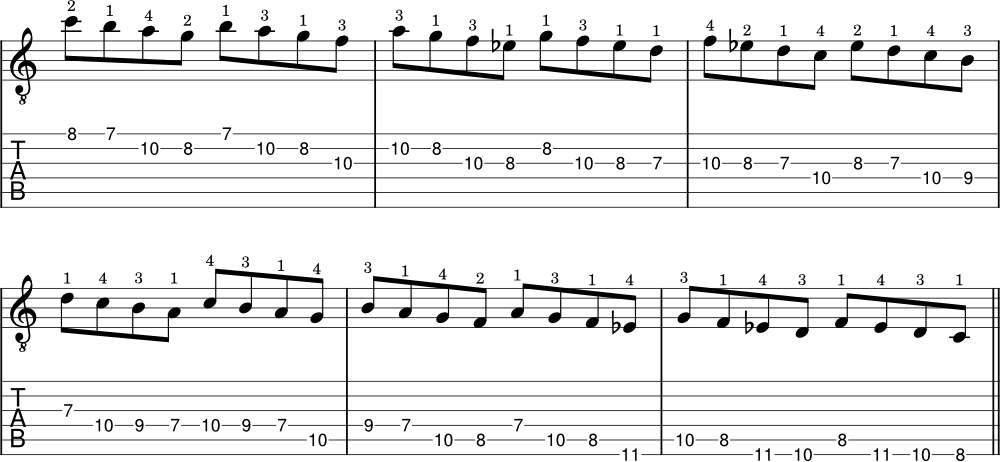
4 note descending scale pattern
This is the same 4 note concept as the previous example except we are descending the melodic minor scale.
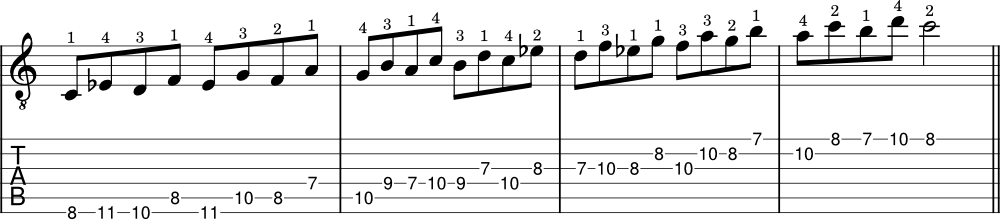
Ascending 3rds scale pattern
For this scale pattern, we are playing intervals of thirds on each degree of the scale. You can think of thirds as skipping the next note of a scale.
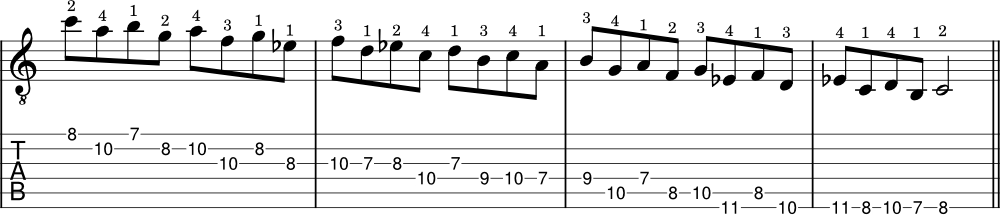
Descending 3rds scale pattern
This is the same concept as before except we are descending in thirds using the C melodic minor scale.
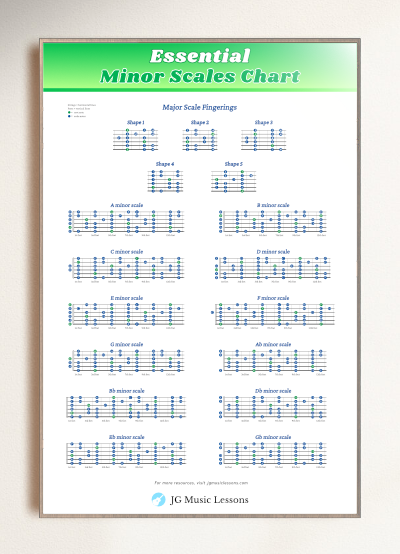
This other guide on how to practice scales covers more application examples such as playing consecutive intervals, skipping by different intervals, and using triads or 7th chord arpeggios. You may also want to learn how to make your melody lines sound jazzy.
How to Practice Melodic Minor
1. Start with one shape
Learn one position well before adding a neighboring shape.
2. Play it with harmony
Play the scale over a minor chord or backing track where the natural 6th and 7th fit the harmony. Listen especially to those notes against the minor 3rd so you begin recognizing the scale by ear.
3. Connect one neighboring shape
Once one position is comfortable, add the position directly above or below it.
Included in Pro Membership ✨
Put on a chord or backing track that fits melodic minor. Using one scale shape, create two short phrases. In the first, use only a few notes and leave space. In the second, make sure you include the b3, 6, or 7 so you can hear the character of the scale.
Wrapping up
Melodic minor contains the same notes as a Major scale except for the lowered 3rd: 1, 2, b3, 4, 5, 6, 7.
Start with one Major scale shape you already know, lower the 3rd, and spend time hearing the difference instead of only memorizing another fingering pattern.
From there, the additional shapes, connected fretboard maps, and scale patterns in this lesson give you more ways to expand the sound across the guitar.
Before continuing
You’re ready to continue when you can turn one familiar Major scale shape into melodic minor by lowering the 3rd, identify the 1, b3, 6, and 7, and use the shape to create a short musical phrase.
Next: Continue in the Mastery Roadmap to keep developing advanced scale sounds and their musical application.
📘 Get the free Practice Blueprint: Build better habits and make your progress more consistent. Download the free guide →