
If you’ve been working through the bending lesson, you already know how to move a note from one pitch to another.
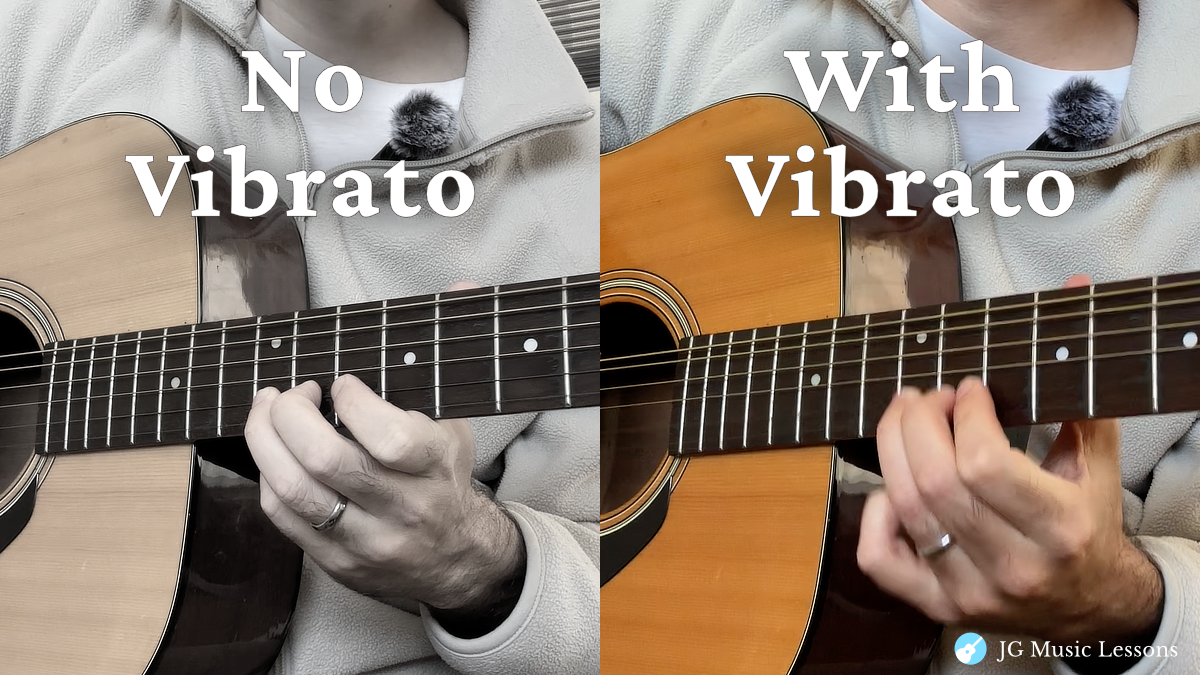
Vibrato gives you another way to shape the note once you arrive. By making a small, repeated change in pitch while the note rings, you can add movement and expression to a sustained note.
In this lesson, you’ll work on the basic vibrato motion, learn how to control its speed and width, recognize how it’s written in music, and apply it to short lead phrases.
Skill Builders Roadmap Focus · View Roadmap →
Start with a slow, even vibrato on one sustained note. Focus on keeping the movement controlled, then experiment with narrower and wider vibrato before adding it to a short lead phrase.
What vibrato is
Vibrato is a small, repeated change in pitch on a sustained note.
The goal is controlled movement. You should be able to choose how wide the vibrato is and how quickly the pitch moves.
Think about a singer holding a note. A completely straight note has one sound. Adding a small, controlled movement around that pitch gives the note a different character.
For the wrist-based vibrato used in most of the examples below, the movement comes mainly from the wrist rather than the finger itself.
How to play vibrato
Two common vibrato motions
One common approach is wrist vibrato, where the string moves slightly across the fretboard. You bend the string slightly, release it, and repeat that small movement at a steady pace. This is common in blues, rock, and other styles of lead guitar.
The classical vibrato method moves the finger back and forth along the length of the string rather than pushing the string across the fretboard. The pitch movement is more subtle and works especially well on nylon-string guitar.
For the lead-playing examples in this lesson, start with wrist vibrato.
Wide vs. narrow vibrato
Width refers to how far the pitch moves during each vibrato movement.
A narrow vibrato can sound subtle and restrained, while a wider vibrato creates a stronger pitch movement.
The speed matters too.
A slow, wide vibrato can work well on a long note at the end of a phrase. A faster, narrow vibrato creates a different effect and can start to sound tense if the movement becomes rushed.
Start with a moderate width and a relaxed pace. Once you can control it consistently, experiment with different speeds and widths.
The wrist motion
Use the same basic wrist rotation you worked on in the bending lesson.
Rotate the wrist slightly to move the string, return to the starting pitch, and repeat. Keep the movement small and controlled instead of trying to create a large bend.
Start slowly. If your vibrato sounds uneven, slow the movement down until you can repeat it at a steady pace. Control matters more than speed.
Vibrato notation and examples
Vibrato can be written in standard notation or tab when a specific effect is wanted, but guitarists also often add it as an expressive choice when holding or emphasizing a note.
A wavy line above a note is commonly used to show vibrato. A regular wavy line indicates a narrower vibrato, while a wider or thicker wavy line can be used to indicate a wider vibrato.
The notation usually doesn’t tell you exactly how fast to play the vibrato. That’s an expressive choice, but the movement should stay controlled and even.
The examples below use the same note so you can hear how different amounts of vibrato change its sound.
Example 1: Sustained note without vibrato
G string, 9th fret. Let the note ring naturally with no pitch movement.

Example 2: Sustained note with regular vibrato
G string, 9th fret. Let the note settle, then add a small, slow, even vibrato.

Example 3: Sustained note with wide vibrato
Play the same note with a wider pitch movement while keeping the motion steady.

Common vibrato mistakes
1. Rushing the movement
If your vibrato sounds uneven or tense, the movement may simply be too fast.
Slow it down and repeat the movement at a steady pace, keeping the vibrato smooth and even. Once that feels controlled, gradually increase the speed.
2. Starting the vibrato too soon
Try letting the note ring cleanly for a moment before adding vibrato.
That small amount of space can make the vibrato sound more deliberate and also helps you hear whether you landed on the correct pitch first.
3. Adding vibrato to every note
Save vibrato for notes you want to emphasize, especially longer notes and natural resting points in a phrase.
Using it selectively gives those notes more weight without crowding the rest of the phrase.
4. Moving only the finger
For the wrist-based vibrato in this lesson, the wrist should provide most of the movement.
If the finger is moving but the pitch barely changes, slow down and check the wrist rotation. Keep the hand relaxed and make the motion small.
Applying vibrato to the B minor pentatonic scale
If you’ve been through the minor pentatonic scales lesson, use B minor pentatonic as the framework for the next 3 phrases.
These examples combine vibrato with bending and the hammer-on and pull-off techniques from the previous lessons. The goal is to start using these techniques together instead of practicing each one in isolation.
Phrase 1: Blues curl and vibrato
This phrase starts with a slight quarter-step bend, often called a blues curl, and ends with vibrato on the final note.

Phrase 2: Hammer-on and pull-off phrase ending with vibrato
This phrase moves through the B minor pentatonic scale using a hammer-on and pull-off, then lets the final note ring with vibrato.

Phrase 3: Vibrato on a bent note
This phrase ends with vibrato on a bent note, which takes a little more control. First reach the target pitch and hold the bend steady. Then add the vibrato while keeping the bent note under control.

Practice routine: 10 to 15 minutes
Minutes 1 to 5: Vibrato on one note
Play the 9th fret on the G string.
Let it ring cleanly for a moment, then add a slow vibrato. Bend the pitch slightly and return to the starting note repeatedly at a slow, steady pace. Focus on keeping the movement smooth and even.
Repeat the same exercise on one or two other strings and frets.
Minutes 6 to 10: Compare vibrato widths
Play the same sustained note with no vibrato, regular vibrato, and wide vibrato. Listen closely to how the width changes the character of the note while keeping the movement steady.
Minutes 11 to 15: Combine the techniques
Choose one of the three phrases and play it at a comfortable tempo. Focus on keeping the vibrato even and any bends controlled.
If part of the phrase keeps breaking down, isolate that technique first, then put it back into the full phrase.
Included in Pro Membership ✨
Wrapping Up
Vibrato gives you a way to add movement and expression to a sustained note. The main goal is being able to control the width and speed instead of letting the movement happen randomly.
Start with a slow, even vibrato on a single note. Then experiment with narrower and wider movements and begin adding vibrato to longer notes inside the phrases you already play.
As you improvise, listen for notes where vibrato fits naturally instead of adding it to every note.
Before continuing
You’re ready to continue when you can keep a steady vibrato on a sustained note, control the width of the movement, and add vibrato naturally to the end of a short lead phrase.
Next: Continue in the Skill Builders Roadmap to keep developing your lead-playing technique and phrasing.