
If you’re looking to spice up your chord progressions, you’ll want to learn about a unique chord called the minor 7 b5 chord (also known as the half diminished chord). These interesting and sophisticated chords add a jazzy and mysterious element to your playing.
In this lesson, we cover the music theory to understand how they work, guitar charts for common minor 7 b5 chords, movable shapes to give you flexibility to play them throughout the fretboard, and application examples to help you learn these versatile chords!
If you haven’t learned the essential 7th chords such as Major 7, dominant 7, and minor 7 yet, I recommend starting with those 7th chords here.
Grab your guitar and let’s get started!
Skill Builders Roadmap Focus · View Roadmap →
Your goal is to understand how a minor 7 b5 chord relates to the minor 7 chords from the previous lesson, then get one movable shape under your fingers and move it to another root note. Use the other chord charts and progression examples as references as you build familiarity.
Minor 7 flat 5 chord formula (also known as half diminished chords)
A half diminished chord is a minor 7 chord with the 5th lowered by one half step. A minor 7 chord uses 1, b3, 5, b7, while a minor 7 b5 chord uses 1, b3, b5, b7.

Here are some half diminished (minor 7 b5) chord examples and what notes they include:
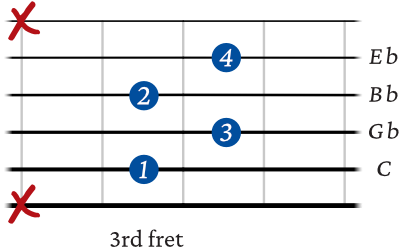
- C minor 7 b5 has the notes C, Eb, Gb, and Bb.
- E minor 7 b5 has the notes E, G, Bb, and D.
- G minor 7 b5 has the notes G, Bb, Db, and F.
You might also see these chords written as “m7b5” or “half dim”.
Comparison exercise: Play a minor 7 chord you already know, then lower only the 5th by one fret to hear how it changes to minor 7 b5. Focus on recognizing which chord tone changed.
How to read the guitar chord charts
For the charts below:
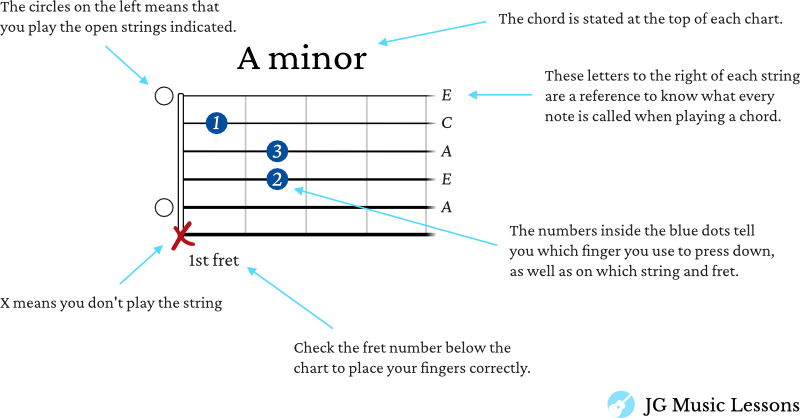
- The lowest horizontal line represents the thickest string (Low E). The top horizontal line represents the thinnest string (high E).
- The vertical lines represent the frets on the guitar (thin metal lines on your guitar fretboard)
- The numbers inside the circles tell you what fingers to use to press down on your fretting hand (see the fingering chart in the following section)
Take a look at the image below to better understand the chord chart symbols.
Use the charts below as a reference: You don’t need to memorize every minor 7 b5 chord here. Start with one comfortable shape and make sure you understand where the root and b5 are before adding more examples.
Minor 7th b5 chord charts
Let’s look at a few chart examples of how to play common minor 7 b5 chords and then learn the movable shapes more systematically in the next section.
C minor 7 b5
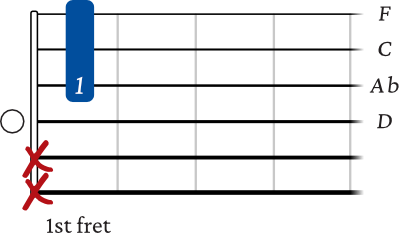
D minor 7 b5
E minor 7 b5
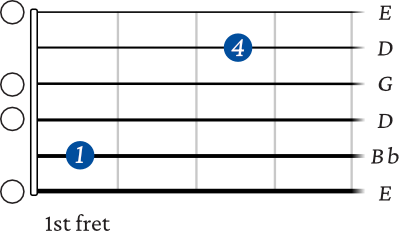
F minor 7 b5
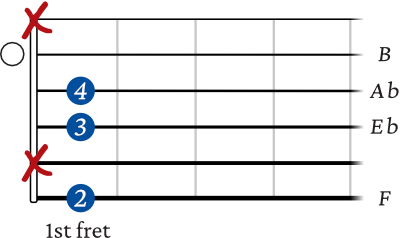
G minor 7 b5
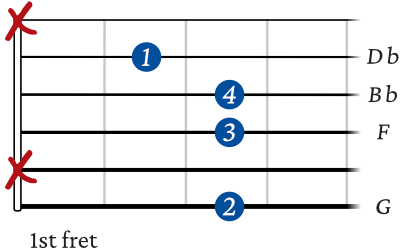
A minor 7 b5
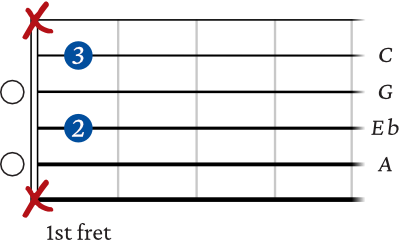
B minor 7 b5
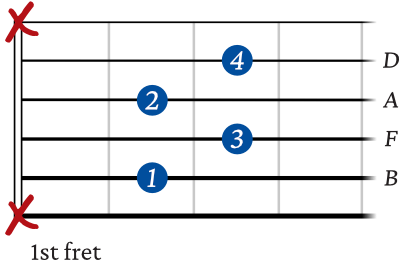
Roadmap practice: Choose one of the movable shapes below. Find its root note, play the chord cleanly, then move the same shape to one other root note. You can explore the other string sets later.
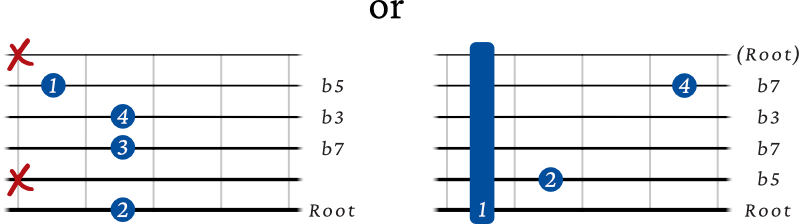
Minor 7th b5 movable shapes – 6th string
Here are the movable half diminished chord shapes starting on the 6th string. If you know the notes on the fretboard, find your root note accordingly to play any half diminished chord.
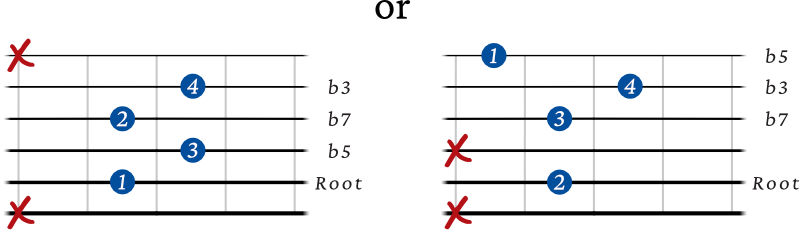
Minor 7th b5 movable shapes – 5th string
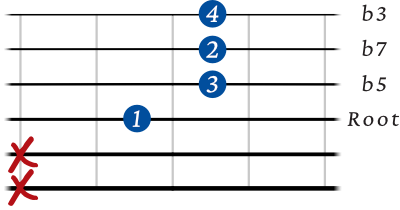
Minor 7th b5 movable shape – 4th string
Minor 7th b5 progression examples
Now let’s hear the chord in context. Choose one progression below and work through it slowly. Listen for where the minor 7 b5 chord appears and how it leads into the surrounding harmony. The other examples are there when you want more practice.
The audio examples are included under the notation. You’ll hear the regular tempo and a slower tempo to help you learn each example.
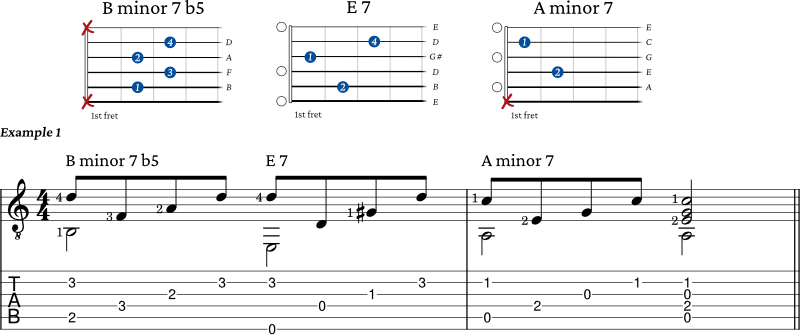
Chord progression 1
Progression 1 chords are B half diminished, E 7, and A minor 7. This would be labeled a “2 5 1” in the key of A minor. This is a common progression in jazz.
Chord progression 2
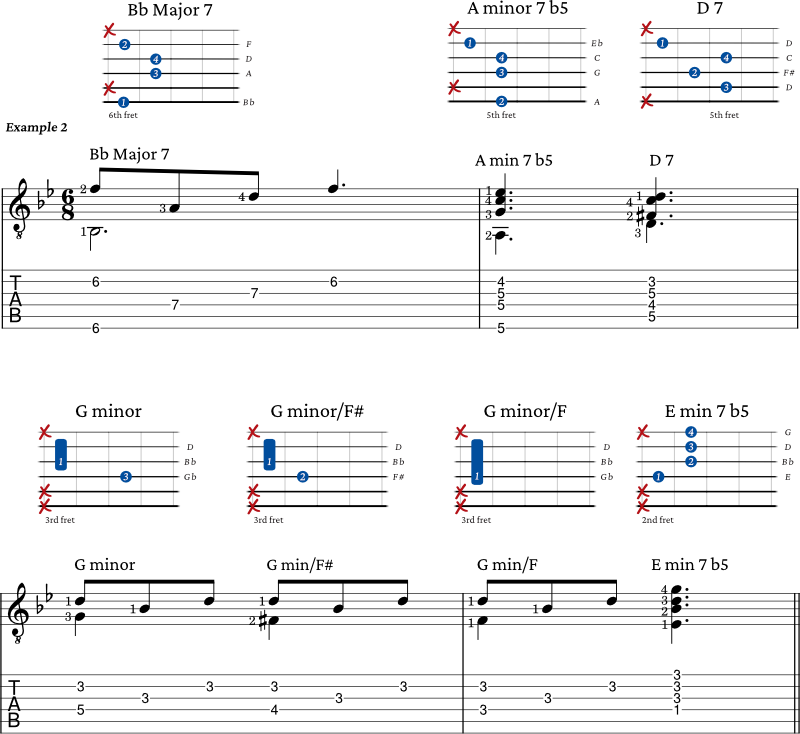
Progression 2 chords are Bb Major 7, A minor 7 b5, D 7, G minor, G minor/F#, G minor/F, and E minor 7 b5.
In this example, the A minor 7 b5 in measure 2 is the “7 chord” in the key of Bb Major or “2 chord” in G minor. The E minor 7 b5 chord in measure 4 finalizes a cliché chord movement starting on the G minor in measure 3.
Side note: G minor 6 and E minor 7 b5 share the same notes so they can be used interchangeably.
Chord progression 3
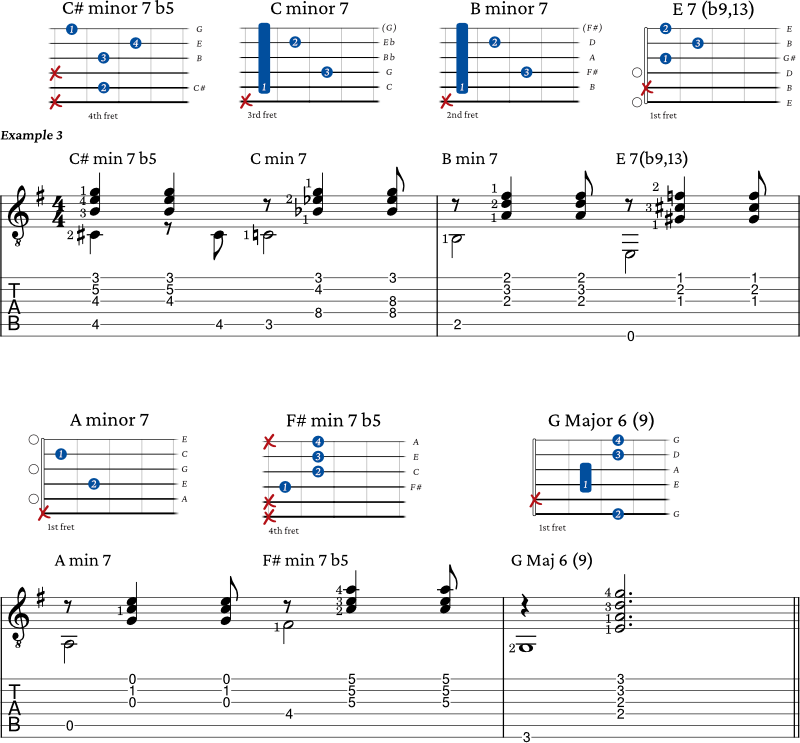
The chords in this last progression are C# minor 7 b5, C minor 7, B minor 7, E 7 (b9,13), A minor 7, F# minor 7 b5, and G Major 6 (9).
The F# minor 7 b5 in measure 3 acts as a substitute for a D 7 (9) chord because it shares most of the notes.
This is a typical jazz chord progression ending. The function of the C# minor 7 b5 acts like a “2 chord” of the 3 chord in the key of G Major. We’re using a Bossa Nova rhythm to switch things up here.
To learn other rich chords like these, check out how to play jazz chords on guitar.
Wrapping Up
A minor 7 b5 chord builds directly on the minor 7 chord you already learned. The root, b3, and b7 stay the same, while lowering the 5th by one fret gives you the formula 1, b3, b5, b7.
Start with one movable shape and practice shifting it to a few different root notes. Then use one of the progression examples above to hear how the chord works in real music.
As the shape becomes more familiar, you can explore the other string sets and progression examples. Minor 7 b5 chords also give you another useful color when creating your own music, and you can go deeper into related harmony in this lesson on jazz chords on guitar.
Before continuing
You’re ready to continue when you can explain that a minor 7 b5 chord uses 1, b3, b5, and b7, show how it differs from a minor 7 chord, and move one minor 7 b5 shape to at least two different root notes.
Next: Continue in the Skill Builders Roadmap to see where this skill fits and what to practice next.
📘 Get the free Practice Blueprint: Build better habits and make your progress more consistent. Download the free guide →