
A minor blues gives you a 12-bar framework for putting chords, rhythm, and improvisation together. In this lesson, we’ll start with a basic minor blues, then explore versions using 7th chords and richer jazz harmony.
We’ll also connect the progression to the blues scale from the previous lesson so you can begin using the scale in a real musical setting. Grab your guitar and let’s get started.
Skill Builders Roadmap Focus · View Roadmap →
Start by learning the basic 12-bar minor blues form and tracking where the 1, 4, and 5 chords occur. Once you can keep your place through the form, use the minor blues scale to create a few short phrases over it, then move the progression to another key.
Minor blues progression
A typical minor blues lasts 12 measures and is built mainly around the 1 minor, 4 minor, and 5 minor chords. In A minor, those chords are A minor, D minor, and E minor.
The chord numbers are what make the form movable. Once you understand where the 1, 4, and 5 happen across the 12 measures, you can apply the same structure in another minor key.
A minor blues chords
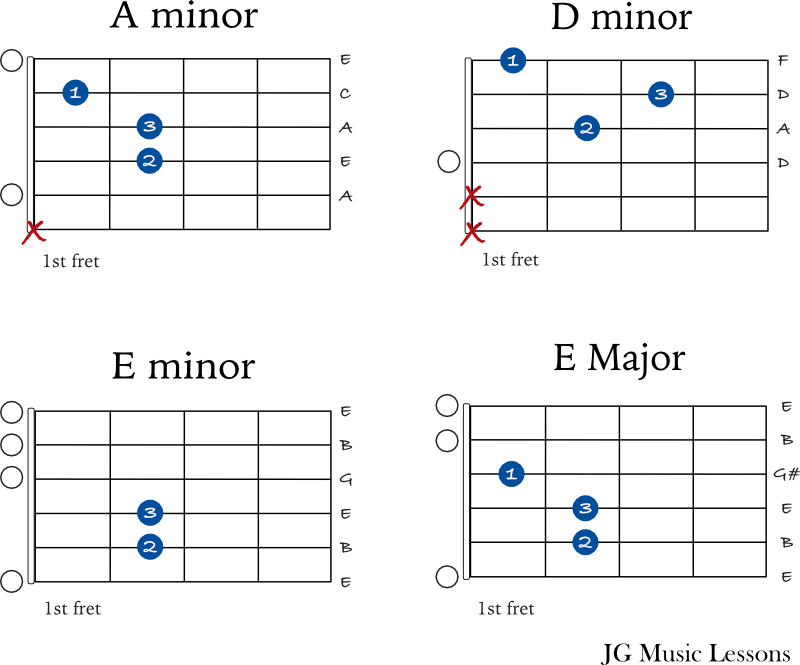
For an easy way to play this progression, here are some open chords you can use in the chart below.
A minor blues progression
The following lead sheet shows the minor blues progression in the key of A minor. Numbers are written above each chord to show how each they relate to the key center (this is known as a numerical chord analysis).
You may also hear the 5 chord changed from minor to Major. This creates a stronger pull back toward the 1 chord and gives you another common variation of the minor blues sound.
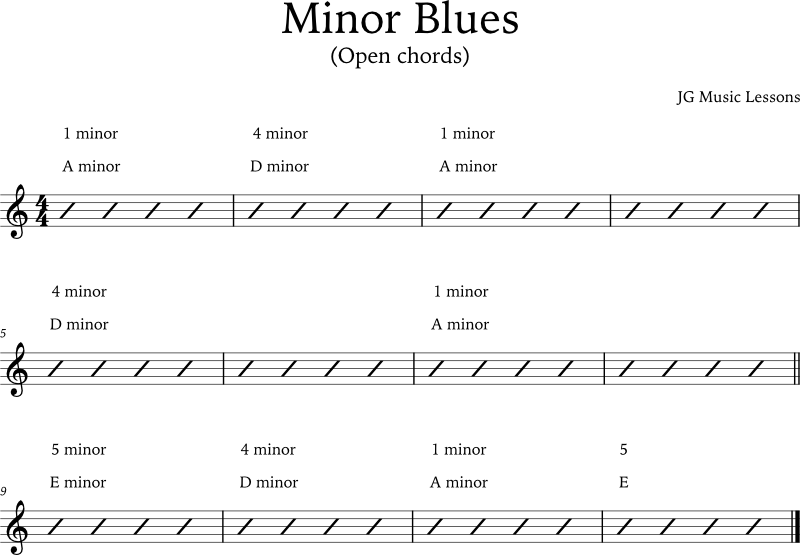
Try this: Play through the full 12-bar form in A minor and say the chord numbers as you go: 1, 4, or 5. Focus on keeping your place in the form rather than restarting when a chord change is late.
Minor blues progression using 7th chords
Once the basic form is clear, you can keep the same 12-bar structure while changing the chord colors. The next example moves the progression to E minor and uses 7th chords.
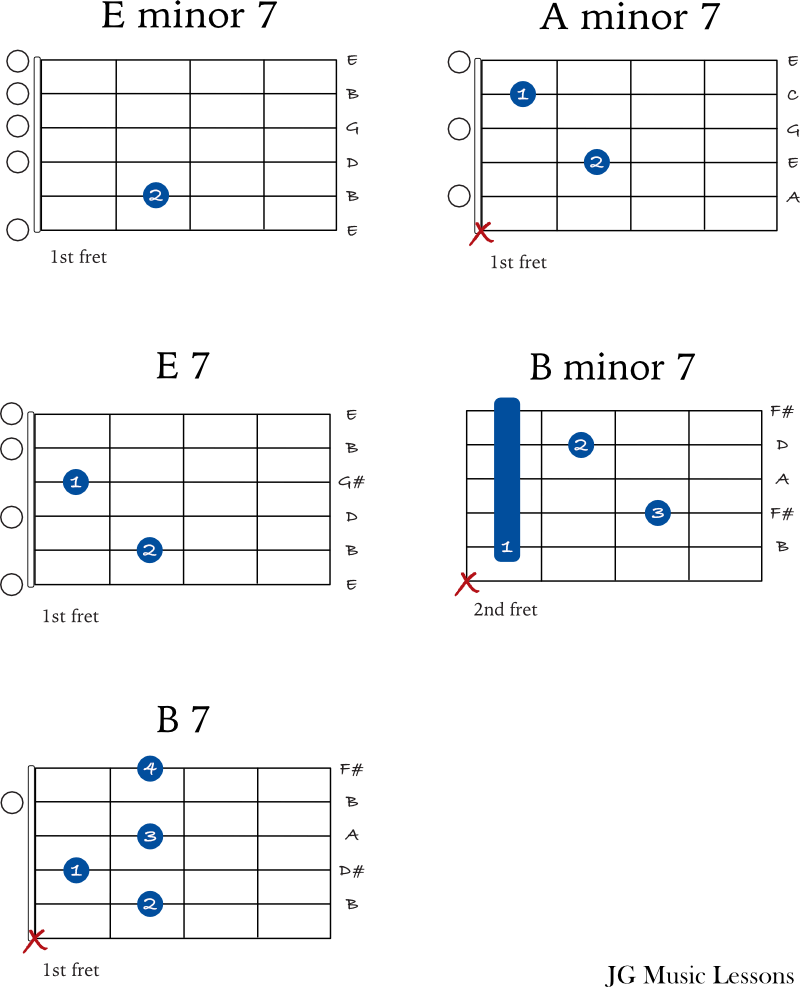
This version includes E minor 7, A minor 7, E 7, B minor 7, and B 7. It also adds a dominant chord that creates extra movement within the progression.
If you want to understand that harmonic idea more deeply, see this lesson on secondary chords.
E minor blues chords
E minor blues progression
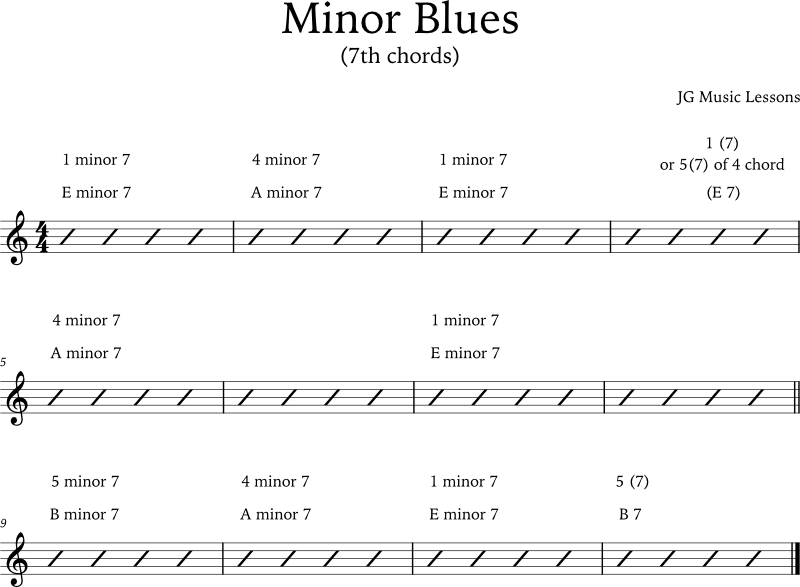
Listen for the connection: The chord colors have changed, but the basic 12-bar framework is still guiding the progression. Keep tracking the form by chord number rather than treating this as a completely new progression.
Minor blues progression using jazz chords
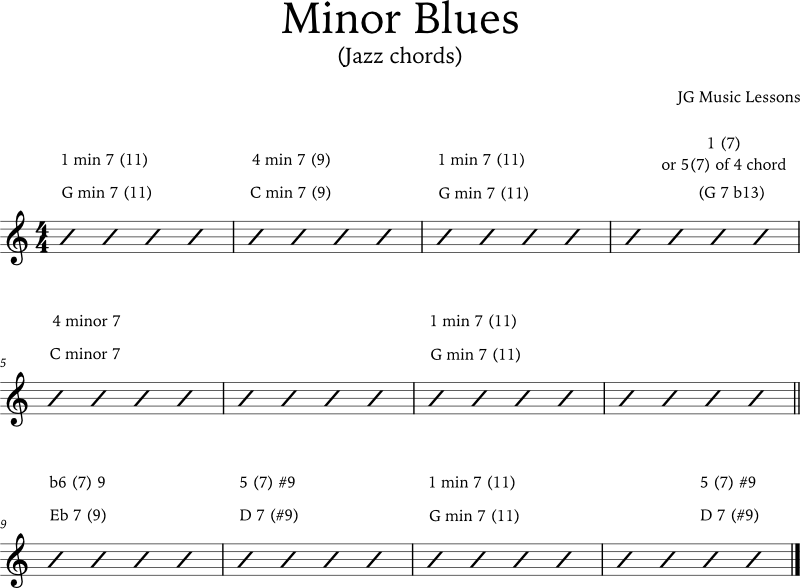
The G minor example takes the same idea further by adding chord extensions and more harmonic movement. Listen to how the richer voicings change the color of the progression while the minor blues framework remains underneath.
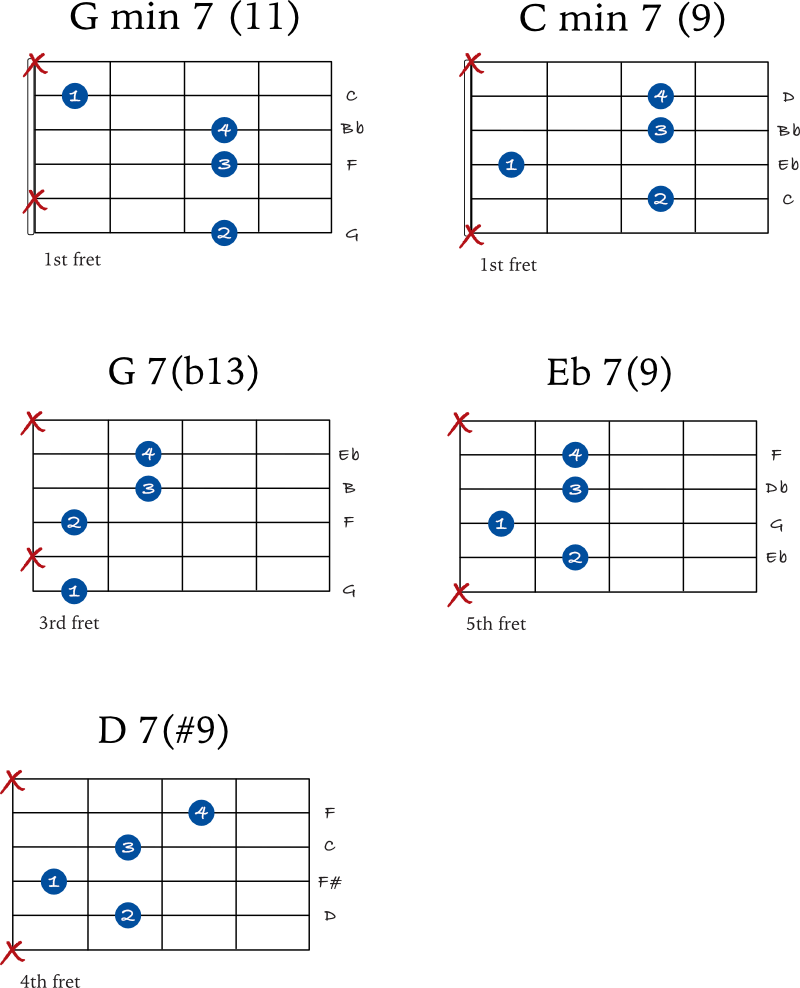
This variation has the chords G minor 7(11), C minor 7(9), G 7(b13), Eb 7(9), D 7(#9).
G minor blues chords
G minor blues progression
Apply the blues scale to the progression
Now connect this progression to the blues scale from the previous lesson. Start with the basic A minor blues and use an A minor blues scale shape you already know.
Rather than running the scale continuously, play a short phrase, leave some space, and listen to the chords underneath. Try repeating one phrase and changing only the ending the next time around.
Try this: Play through one complete 12-bar chorus and add a few short minor blues scale phrases while keeping track of where you are in the progression. If you lose your place, listen for the chord change and rejoin the form rather than starting over.
Minor blues chords in all keys
The chart below shows the basic 1 minor, 4 minor, 5 minor, and Major 5 chords from different root notes. Use the chord numbers to move the same minor blues framework into another key.
| 1 minor chord (key center) | 4 minor chord | 5 minor chord | 5 chord |
|---|---|---|---|
| C minor | F minor | G minor | G Major |
| Db minor | Gb minor | Ab minor | Ab Major |
| D minor | G minor | A minor | A Major |
| Eb minor | Ab minor | Bb minor | Bb Major |
| E minor | A minor | B minor | B Major |
| F minor | Bb minor | C minor | C Major |
| Gb minor | B minor | Db minor | Db Major |
| G minor | C minor | D minor | D Major |
| Ab minor | Db minor | Eb minor | Eb Major |
| A minor | D minor | E minor | E Major |
| Bb minor | Eb minor | F minor | F Major |
| B minor | E minor | F# minor | F# Major |
Try another key: Choose one row from the chart and play the basic 12-bar form using those chords. Keep the chord numbers in mind so you’re moving the progression as a structure rather than memorizing a second set of chord changes.
Once you know the root note for every chord in a 12 bar blues, you can try applying them to the 3 chord progression variations we covered in this lesson starting from easy to more advanced variations.
Wrapping up
The minor blues gives you a 12-bar framework you can recognize and reuse in different keys. Once you understand where the 1, 4, and 5 chords happen, the chord voicings can change without losing the structure underneath.
Start with the basic form, then experiment with 7th chords and richer harmony as the progression becomes more familiar. Most importantly, connect the progression to the blues scale by creating short phrases and listening to how they sit against the chords.
When you’re comfortable in one key, move the form to another key using the 1, 4, and 5 relationship. You can also explore these jazz and blues licks for more phrase ideas.
Before continuing
You’re ready to continue when you can keep your place through a 12-bar minor blues, identify the 1, 4, and 5 chords, use the minor blues scale for a few short phrases over the form, and move the basic progression to another key.
Next: Continue in the Skill Builders Roadmap to keep applying scales and fretboard ideas in musical situations.
📘 Get the free Practice Blueprint: Build better habits and make your progress more consistent. Download the free guide →