
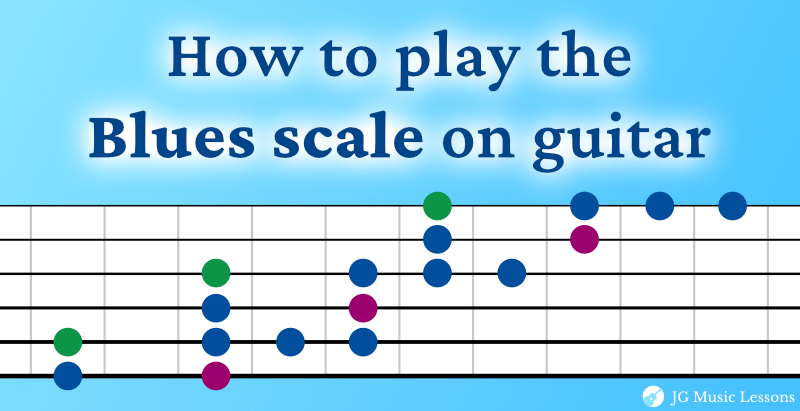
The blues scale builds on the pentatonic scale by adding one chromatic note that gives it a more distinctive sound. You’ll hear it across blues, rock, jazz, pop, and many other styles.
In this lesson, we’ll compare the Major and minor blues scales, see how the added “blue note” changes the pentatonic sound, learn the five fretboard shapes, and apply them through patterns and musical ideas.
Grab your guitar and let’s get started.
Skill Builders Roadmap Focus · View Roadmap →
Start with a pentatonic shape you already recognize and find the added blue note inside it. Listen to how that one note changes the sound, then use it inside a short phrase and connect the idea into one neighboring position.
Blues Scale Formula
The blues scale is based on the pentatonic scale with one added chromatic note. This added note is commonly called the blue note.
There are Major and minor versions of the blues scale. Comparing them with their pentatonic scales makes the relationship easier to see.
Major Blues Scale Formula
The Major blues scale uses 1, 2, b3, 3, 5, and 6. It comes from the Major pentatonic scale with the b3 added between the 2nd and 3rd degrees.
For example, C Major blues contains C, D, Eb, E, G, and A.

You can learn the C Major pentatonic here if you don’t know it already.
Minor Blues Scale Formula
The minor blues scale uses 1, b3, 4, #4, 5, and b7. It comes from the minor pentatonic scale with the #4 added between the 4th and 5th degrees.
For example, A minor blues contains A, C, D, D#, E, and G.

Major Blues Scales Examples
The examples below show the same Major blues formula from several root notes. As you compare them, notice how the scale degrees stay the same while the note names and fretboard position change.
Even though these blues scale examples are written 4/4 time, you can apply the notes to any time signature.
C Major Blues Scale
The C Major blues scale has the notes C, D, Eb, E, G, and A. The small numbers on top of the notes represent the suggested fingerings for your fretting hand.

E Major Blues Scale
The E Major blues scale has the notes E, F#, G, G#, B, and C#.
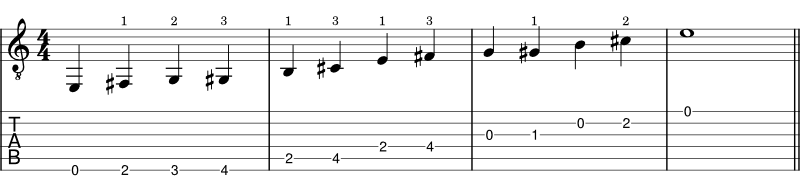
A Major Blues Scale
The A Major blues scale has the notes A, B, C, C#, E, and F#.

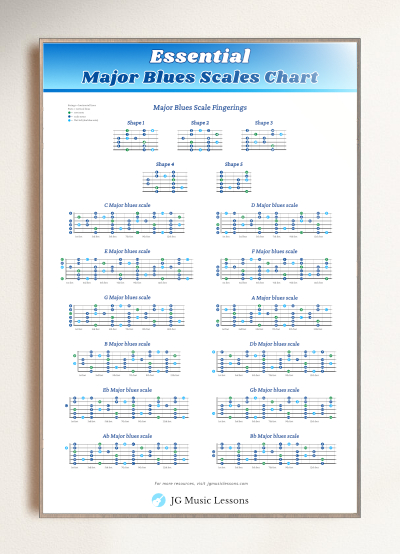
Major Blues Scales Chart
Here is a chart of all the Major blues scales starting on every root note.
| Major blues scale | 1 | 2 | b3 | 3 | 5 | 6 |
|---|---|---|---|---|---|---|
| C Major blues scale | C | D | Eb | E | G | A |
| D Major blues scale | D | E | F | F# | A | B |
| E Major blues scale | E | F# | G | G# | B | C# |
| F Major blues scale | F | G | Ab | A | C | D |
| G Major blues scale | G | A | Bb | B | D | E |
| A Major blues scale | A | B | C | C# | E | F# |
| B Major blues scale | B | C# | D | D# | F# | G# |
| Db Major blues scale | Db | Eb | E | F | Ab | Bb |
| Eb Major blues scale | Eb | F | Gb | G | Bb | C |
| Gb Major blues scale | Gb | Ab | B | Bb | Db | Eb |
| Ab Major blues scale | Ab | Bb | B | C | Eb | F |
| Bb Major blues scale | Bb | C | Db | D | F | G |
Minor Blues Scales Examples
Now compare the minor blues scale in several keys. Keep locating the root and blue note inside each example instead of relying only on the fret numbers.
A Minor Blues Scale
The A minor blues scale uses the same pitches as the C Major blues scale, but A functions as the minor root instead of C as the Major root.
This is another example of the relative Major and minor relationship you’ve seen with pentatonic scales.
Here is an A minor blues scale which has the notes A, C, D, D#, E, and G.

If you know your Major scale shapes, you will see how the relative minor scale includes the same notes.
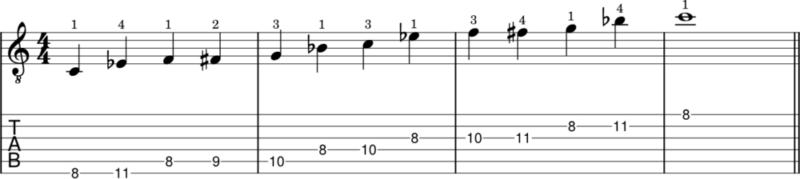
C Minor Blues Scale
The C minor blues scale has the notes C, Eb, F, F#, G, and Bb.
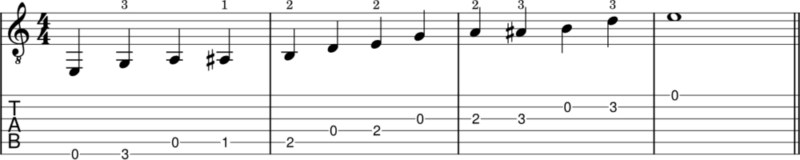
E Minor Blues Scale
The E minor blues scale has the notes E, G, A, A#, B, and D.
Minor Blues Scales Chart
Here is a chart of all the minor blues scales starting on every root note.
| Minor Blues Scale | 1 | b3 | 4 | #4 | 5 | b7 |
|---|---|---|---|---|---|---|
| C minor blues scale | C | Eb | F | F# | G | Bb |
| D minor blues scale | D | F | G | G# | A | C |
| E minor blues scale | E | G | A | A# | B | D |
| F minor blues scale | F | Ab | Bb | B | C | Eb |
| G minor blues scale | G | Bb | C | C# | D | F |
| A minor blues scale | A | C | D | D# | E | G |
| B minor blues scale | B | D | E | F | F# | A |
| Db minor blues scale | Db | E | Gb | G | Ab | B |
| Eb minor blues scale | Eb | Gb | Ab | A | Bb | Db |
| Gb minor blues scale | Gb | A | B | C | Db | E |
| Ab minor blues scale | Ab | B | Db | D | Eb | Gb |
| Bb minor blues scale | Bb | Db | Eb | E | F | Ab |
Now that you have a better understanding of the music theory behind the Major and minor blues scales, let’s start learning the scale shapes throughout the fretboard.
5 Blues Scale Shapes on Guitar
The blues scale notes repeat across the fretboard in five connected positions. These shapes follow the pentatonic framework you already learned, with the blue note added inside each position.
As you work through the shapes, keep locating three things: the root, the familiar pentatonic notes, and the added blue note.
How to read the scale charts
For the charts below:
- Lowest horizontal line represents the thickest string (Low E) and the top horizontal line represents the thinnest string (high E).
- The green circles represent the root note of the Major blues scale.
- Purple notes represent the root note of the minor blues scale.
- Blue is every other note in between.
- Light blues indicates the “blue note”.
- The numbers inside the circles represent the suggested fingering to use on your fretting hand.
Relative Major and minor blues scales can share the same pitch collection while emphasizing different root notes.
If needed, check out how to read guitar notation symbols.

Blues Scale Shape 1
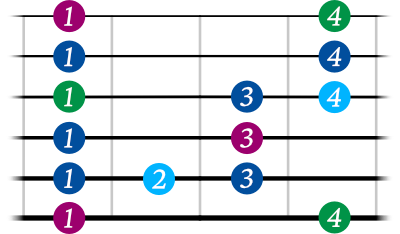
Blues Scale Shape 2
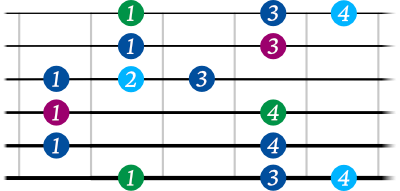
Blues Scale Shape 3
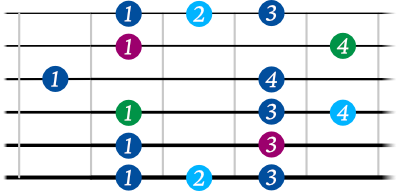
Blues Scale Shape 4
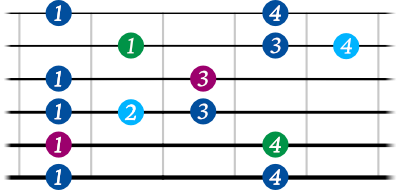
Blues Scale Shape 5
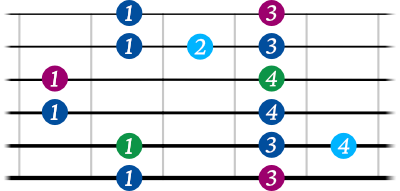
One thing to note about using these shapes is that whenever you have scales where you can use open strings, you will have to rearrange your fingers to play the shape. For example, if a shape includes the fingering 1, 3, and 4 on one string, you can play (open string), 1 and 3 instead.
Although you will need to change some shapes if you include open strings, once you move over to the next shape where you’re fretting all the notes, you will get back to the original shapes we covered here.
Roadmap practice: Choose one blues-scale shape and first play it without the blue note so you hear the underlying pentatonic sound. Then add the blue note back in. Create a short phrase that uses the blue note as a passing sound rather than simply running the full scale up and down.
Blues Scale Guitar Patterns
The patterns below give you different ways to move through the blues scale and break away from always playing it straight up or down.
Start with one pattern and listen for where the blue note appears. Then change the rhythm, ending, or direction to turn the pattern into a short phrase of your own.
6 Note Ascending Blues Scale Pattern
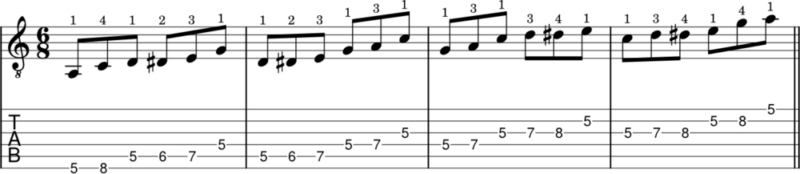
For this 6 note pattern, I’m playing the 6 notes of the blues scale starting from the lowest string and then starting the consecutive pattern again on the next string (6th, 5th, 4th, then 3rd string). I start each pattern on the 1st note of the scale shape rather than thinking about what degree comes next.
Check out the example to show you what I mean.
6 Note Descending Blues Scale Pattern
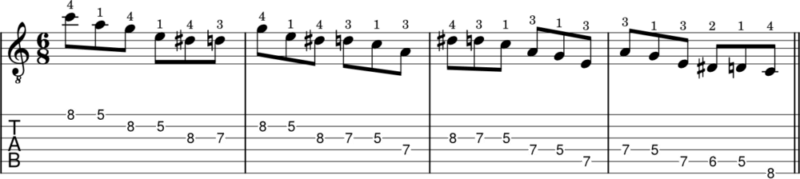
This is the same concept as the last example, except you move down the blues scale in a 6 consecutive note pattern.
8 Note Ascending Blues Scale Pattern
For this pattern, we’re playing an eight-note sequence drawn from the blues scale, then restarting the pattern from the next position.
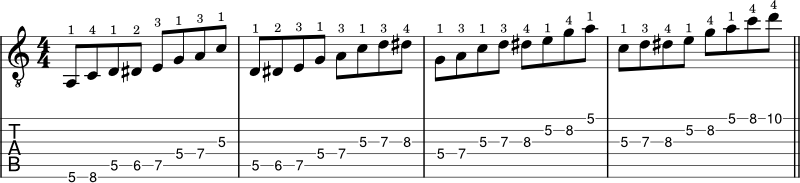
8 Note Descending Blues Scale Pattern
This is the same idea as the previous example, but it moves through a descending eight-note sequence drawn from the blues scale.

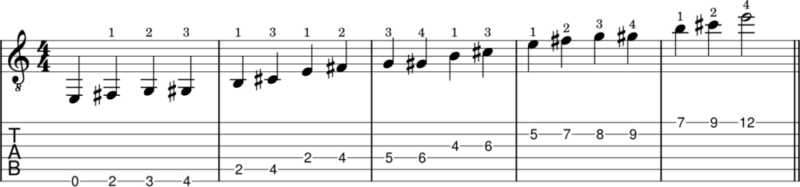
Ascending Blues Scale – 3 Octaves
This example carries the blues scale across three octaves so you can see how the notes connect beyond a single position.
Roadmap practice: Notice where you leave one familiar shape and enter the next. Pick one of those connection points and practice moving through it in both directions.
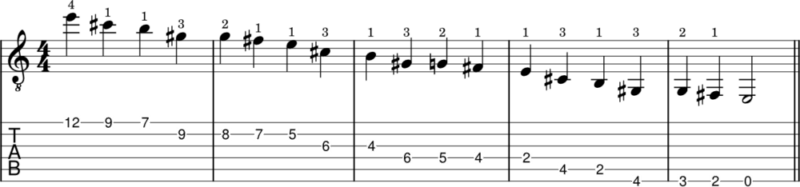
Descending Blues Scale – 3 Octaves
This pattern is the same as the previous example but moving down the notes of the scale in 3 octaves.
For more ideas to incorporate the blues scale in improvisation, check out these 7 jazz and blues licks over a dominant 7 chord.
3 Tips for Memorizing the Blues Scale Shapes
1. Learn one shape at a time
Start with one shape that feels comfortable under your fingers. Learn where the root and blue note appear inside it, then use that position as a reference point for the neighboring shapes.
2. Look for repeating fingering patterns
You want to look for patterns such as what strings repeat the same fingering within a shape.
Quick tip: The notes on the first and sixth string will always be the same.
For example, in shape 1 we see that the 1st, 2nd, and 6th string follow a 1 and 4 finger pattern.
Knowing where fingering patterns repeat will help you build a mental map of a scale shape.
3. Connect shapes around the ones you learned
Once one shape feels familiar, connect it to the position directly before or after it. Look for overlapping notes and practice crossing between the two shapes without stopping.
Included in Pro Membership ✨
Wrapping up
The blues scale builds directly on the pentatonic shapes you’ve already learned. The main difference is one added chromatic note that gives you another sound to use inside a phrase.
Choose one familiar position, know where the root and blue note are, and experiment with using that blue note between stronger scale tones. Then connect the idea to a neighboring shape so your phrases can move across more of the fretboard.
You can also apply these sounds over a 12-bar blues or explore a minor blues progression to hear the scale in a musical setting.
For more phrase ideas, see these jazz and blues licks.
Before continuing
You’re ready to continue when you can identify the root and blue note inside one blues-scale shape, use the blue note intentionally in a short phrase, and move that phrase into one neighboring position.
Next: Continue in the Skill Builders Roadmap to keep developing how you practice and apply scales across the fretboard.
📘 Get the free Practice Blueprint: Build better habits and make your progress more consistent. Download the free guide →