
The blues is one of the music styles that many guitarists love because it’s a simple yet fun chord progression that allows for improvisation and an exchange of musical ideas amongst musicians.
A standard blues is also commonly referred to as a 12 bar blues, meaning it has 12 measures to make up the entire form. In its most basic form, the blues is made up of 3 chords: the 1, 4, and 5 chord in relation to the key of the song.
In today’s lesson, we are covering 3 levels of harmony (chords) you can use to play a blues form on the guitar using:
- Power chords
- 7th chords
- Jazz chords (extended harmony)
Before explaining what chords you can use in a blues, let’s first go over some basic harmony included in 12 bar blues form. Feel free to skip this section if you’re already familiar with this.
Skill Builders Roadmap Focus · View Roadmap →
Your goal is to understand the 12-bar form and the 1, 4, and 5 chord relationship, then play one complete 12-bar blues in A using dominant 7th chords. Use the power-chord version as an optional starting point and the jazz-chord version as deeper study.
Understanding the number system
To follow chord changes in a form, you should be familiar with the number system to know what the related chords are used in any given key.
For example, here are the chord qualities that start on each degree of a Major scale:
- Degrees 1, 4 and 5 are Major chords.
- Degrees 2, 3, and 6 are minor chords.
- 7th degree is a diminished chord.
In the key of C Major these are your diatonic chords (meaning the related chords to the key):
- 1 is C Major
- 2 is D minor
- 3 is E minor
- 4 is F Major
- 5 is G Major
- 6 is A minor
- 7 is B diminished
For this lesson, focus on the 1, 4, and 5 chords. Those are the three chord numbers that make up the basic 12-bar blues form. The full list above is useful for understanding the key, but you don’t need to memorize every chord before continuing.
Using this number system will help find all the related chords to any key.
Basic 12 bar blues form
Regardless of what key you want to play in, here are the following chords in a blues progression. I’ll choose the key of A for this example.

First goal: Follow the form from beginning to end and be able to point out where the 1, 4, and 5 chords happen. Before changing chord types or rhythms, make sure you can keep your place through all 12 measures.
Although you can play this with open chords, there are much better ways to get a more authentic blues sound. For example, all these chords can be changed into 7th chords and we can also change the rhythm which will be explained in more detail later on in this lesson.
Now that we have an understanding of the chord progression in its basic form, let’s go through the different ways we can play this, starting from the simplest to more advanced harmony.
Optional starting point: If the 12-bar form itself is still new, use the power-chord version first. The simpler shapes let you focus on keeping your place through the 12 measures before adding fuller harmony.
Level 1: Blues with power chords
In this first level, we’ll use power chords to play the blues form. These power chords are simple chord structures that don’t include the 3rds of a chord, which indicate whether a chord has a Major or minor quality. You can check this link to learn more about triads if you want to understand this in more detail.
These power chords are movable shapes, which make it a very simple and straightforward approach that sound more like rock.
Power chords are notated by a number 5 next to the root note because you only play the root and interval of a 5th.
Power chord charts
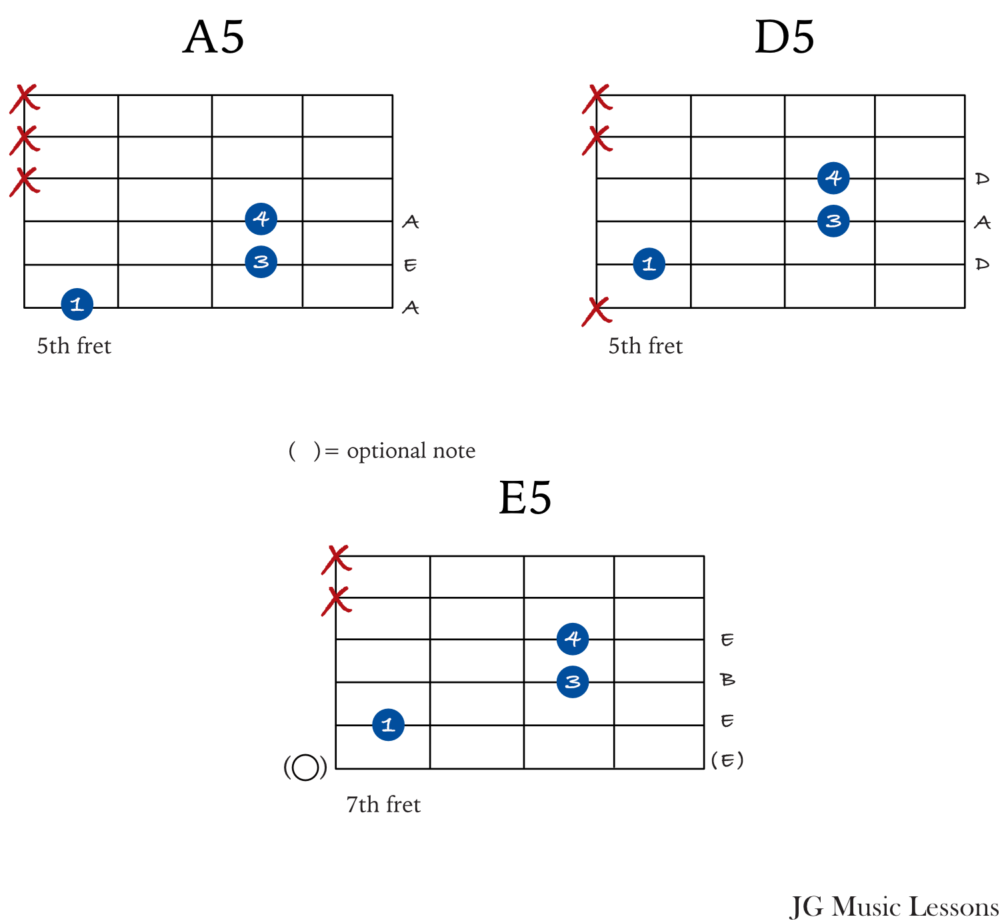
Here is what the 3 chords look like in power chord form:
Blues with power chords – rhythm example
Here is a blues progression using power chords only. The rhythm is kept pretty simple to reflect the style of chords we’re using here.

Level 2: Blues with 7th chords
Try this: This is the main version to work on. Play the full 12-bar form using A7, D7, and E7. Focus first on staying in the form and changing chords in the right measures. Add the swing rhythm once the chord changes feel comfortable.
To take things to the next level, we start to use 7th chords which are a characteristic sound that makes the blues unique. 7th chords contain another note above a triad and are made up of the chord tones 1, 3, 5, and 7. Depending on the 3rd and 7th degree, you can form different 7th chords such as Major 7, dominant 7th, minor 7 or half diminished (minor 7 b5).
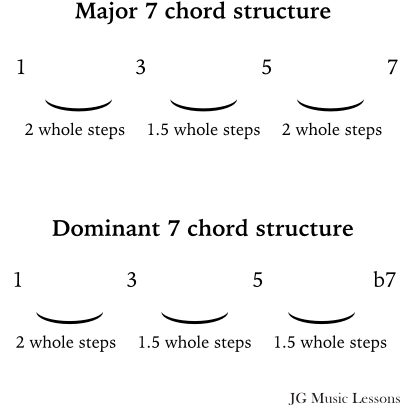
If we use the diatonic chords, we would usually use Major 7 chords on the 1 and 4 chord. However, when playing blues, you would use Dominant 7 chords on the 1 and 4 chord. Even though some notes don’t technically ‘fit the key’, these chords sound good when played in a sequence.
You can compare the difference between Major 7 and Dominant 7 chords with this chart below:
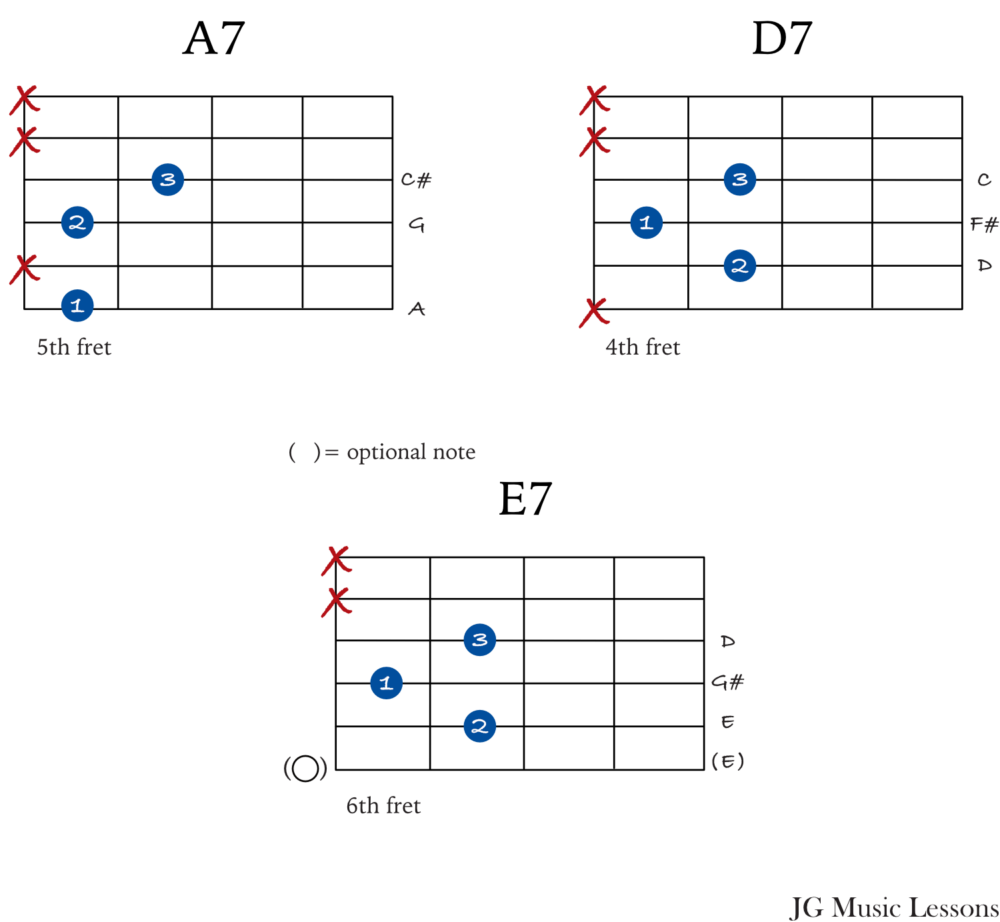
When playing 7th chords, you only need to play certain notes to highlight the chord quality. For example, even if you only play the 3rd and 7th of a chord, you get the important notes that make up a chord’s structure and sound. You can also add root notes to give more emphasis on a particular chord. By playing the root, 3rd, and 7th of a chord, you get what are called shell chords.
7th chord charts
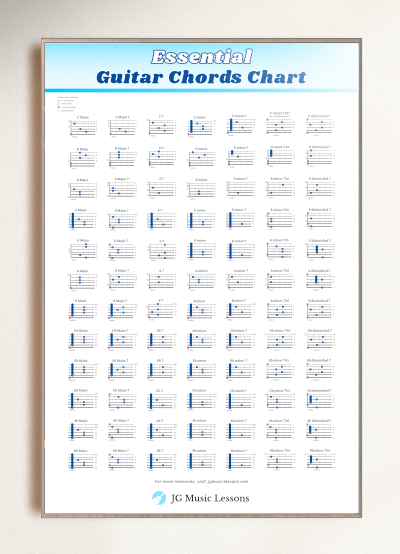
Take a look at what these 7th chords using shell chord shapes would look like in a blues in A. The 3 chords are A 7, D 7 and E 7.
Blues with 7th chords – rhythm example
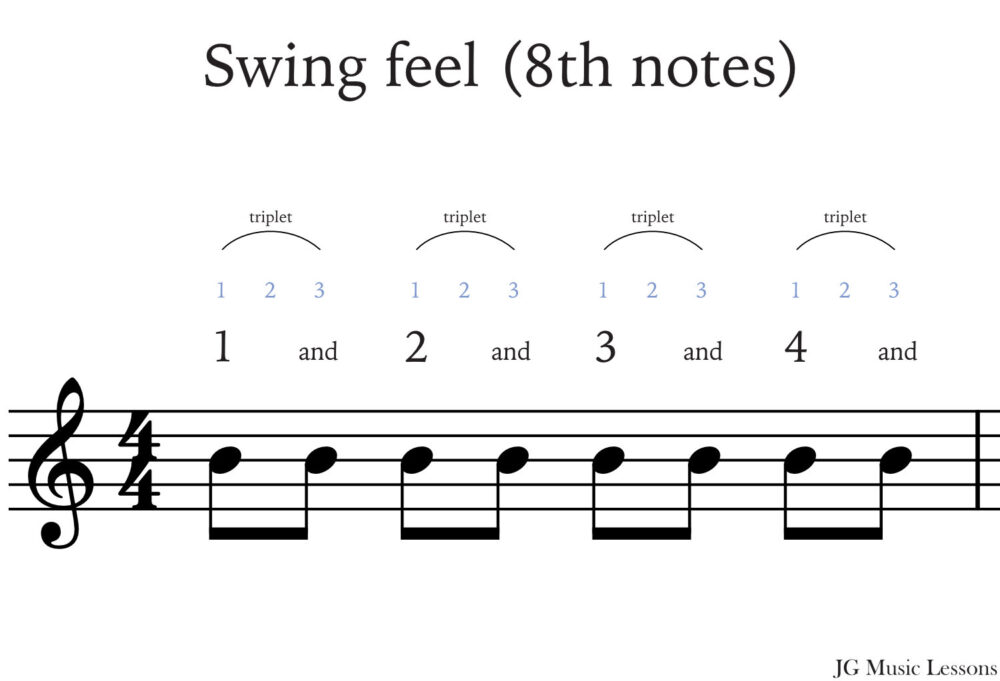
For the rhythm in level 2, we can play the form in swing feel which you also hear in jazz. Instead of playing straight 8th notes which are equally divided in time, swing feel lengthens the notes of certain 8th notes. You could think of the ‘and’ of each beat as the third beat of a triplet. Check out the image below to show you what I mean.
Here is the blues form now using all 7th chords:

Go deeper: The next version adds chord extensions, passing harmony, and more rhythmic detail. Explore it once you’re comfortable playing the basic form with dominant 7th chords. You don’t need these extended shapes before continuing in the Roadmap.
Level 3: Blues with jazz chords
In level 3, we start using more advanced harmony which uses chord extensions past the 1, 3, 5, and 7 chord tones. These can be referred to as jazz chords which you also hear in blues and use chord extensions like the 9th, 11th, and 13th which can sound fuller and richer.
Building upon the previous shell chords, we’ll add these extensions to the shapes covered in level 2.
Jazz chord charts
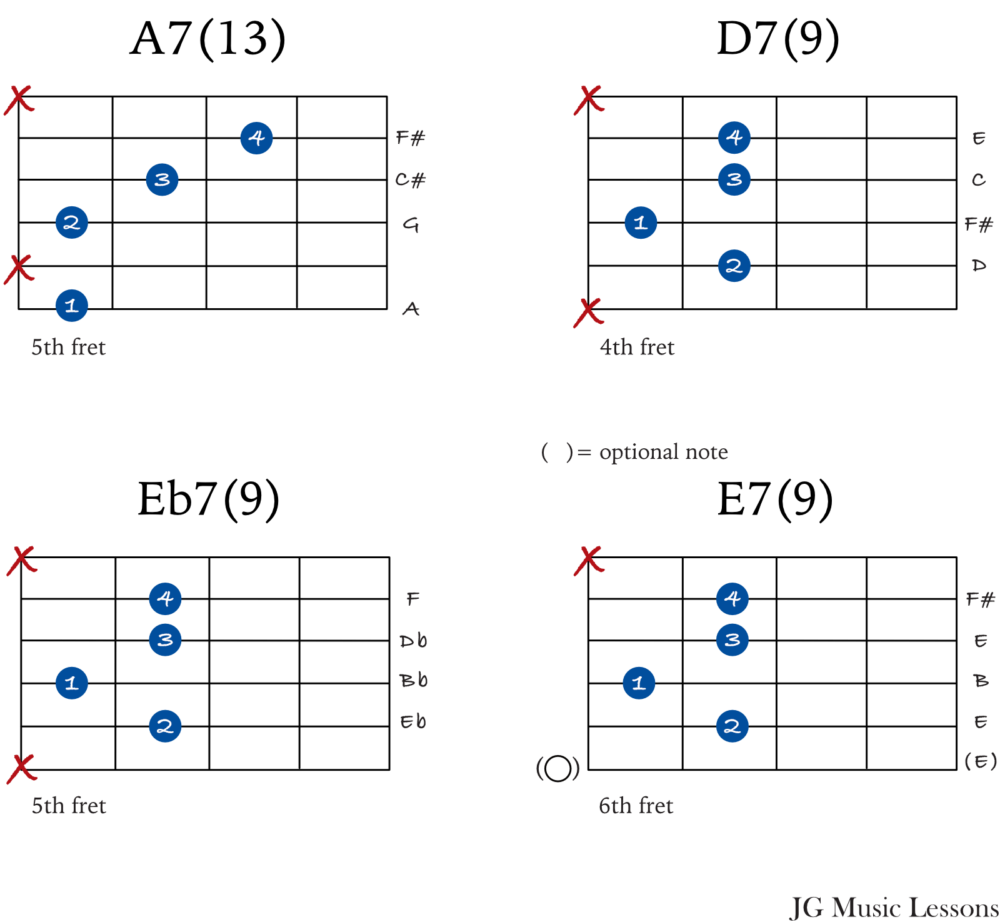
Here are the chord shapes we will be using for the example ahead. As you can see, we are adding one more chord that acts as a passing chord between the E7(9) and D7(9) in measure 9.
Blues with jazz chords – rhythm example
For the rhythm, we are keeping the swing feel and also adding more accents throughout the form. You will see that some chords are anticipated by playing on the ‘and’ of beat 4 on the previous measure.

12 bar blues chords chart
The chart below shows the 1, 4, and 5 chords in different keys. Use it when you want to move the same 12-bar form to another key. You don’t need to memorize the whole chart.
| Key center (1 chord) | 4 chord | 5 chord |
|---|---|---|
| C | F | G |
| Db | Gb | Ab |
| D | G | A |
| Eb | Ab | Bb |
| F | Bb | C |
| Gb | B | Db |
| G | C | D |
| Ab | Db | Eb |
| A | D | E |
| Bb | Eb | F |
| B | E | F# |
Once you know the root note for every chord in a 12 bar blues, you can experiment with the chords we covered in this lesson from easy to more advanced variations.
Wrapping up
A standard 12-bar blues gives you a simple form built around the 1, 4, and 5 chords. Once you know where those chords happen across the 12 measures, you can change the chord shapes and rhythms without losing the structure underneath.
Start by playing the full form in A with A7, D7, and E7. Keep track of the measures and chord changes first, then add the swing rhythm when the form feels comfortable.
From there, you can move the form to other keys, explore the extended harmony in the jazz version, or continue with the minor blues progression. You can also use the pentatonic scale and blues scale when you begin improvising over the form later in the Roadmap.
If you want to explore the richer harmony from Level 3, see this lesson on how to build extended chords on guitar.
Before continuing
You’re ready to continue when you can explain that a basic 12-bar blues uses the 1, 4, and 5 chords, keep your place through all 12 measures, and play the complete form in A using A7, D7, and E7.
Next: Continue in the Skill Builders Roadmap to review Module 1 and see what to practice next.
📘 Get the free Practice Blueprint: Build better habits and make your progress more consistent. Download the free guide →