
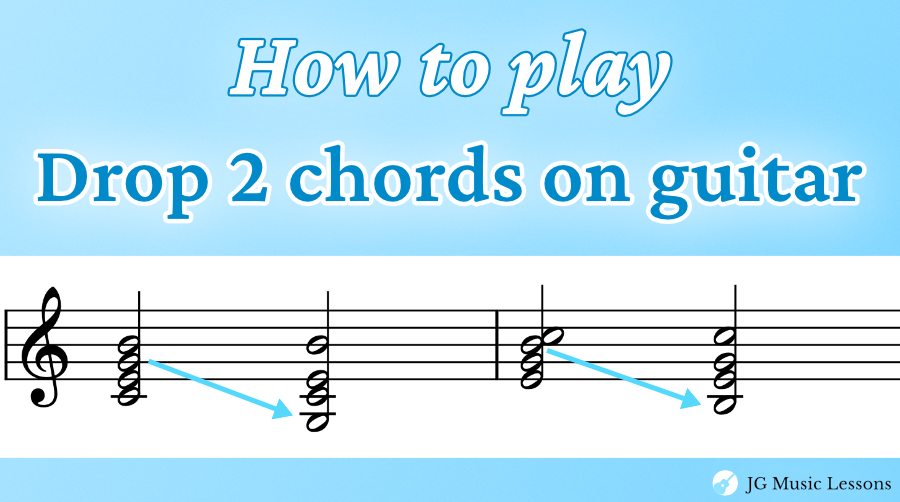
Drop 2 chords rearrange the notes of a 7th chord to create wider, more playable voicings on guitar.
In the previous lesson, you used spread triads to open up three-note chords. Here, you’ll apply a similar idea to four-note 7th chords and use different inversions to move more smoothly through chord progressions.
In this lesson, you’ll learn how drop 2 chords are built, explore Major 7 and minor 7 shapes across the fretboard, and apply them in musical examples.
Mastery Roadmap Focus · View Roadmap →
Start with one Major 7 chord and learn its four drop 2 inversions on a single string set. Then use the nearest shapes to move between two 7th chords without making a large jump across the fretboard.
What is a chord voicing?
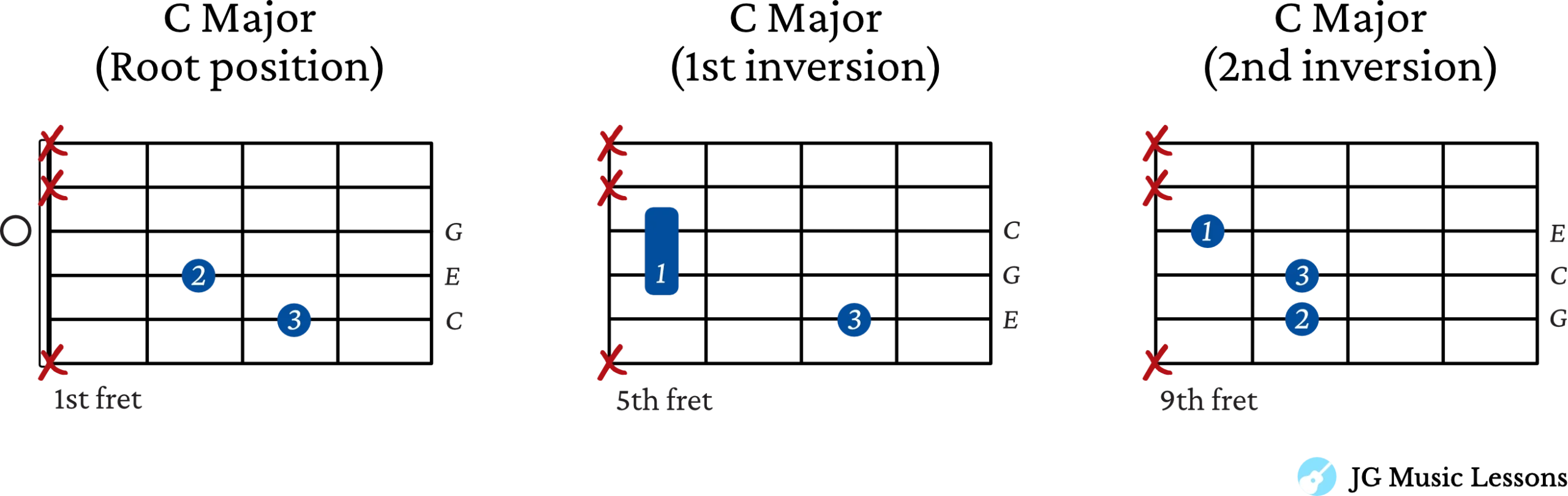
A chord voicing is simply the way a chord’s notes are arranged and spaced. You can play the same chord in several places on the guitar while changing which note is lowest and how far apart the notes are.
For example, even though the following shapes all use the same three notes, their order and spacing change how the chord sounds and feels. See the charts below.
What are chord tones?
Chord tones are the notes that define a chord’s quality, whether it is Major, minor, dominant, or something else.
For example:
- The chord tones 1, 3, 5 create a Major triad.
- The tones 1, b3, 5 create a minor triad.
Once you’ve learned open and barre chords (which are based on these triads), the next step is to explore 7th chords, which add one more note (the 7th) for a richer, more complex sound.
To review the foundation, you can check out this lesson to help you unlock Major triads on guitar.
A 7th chord adds a fourth chord tone to a triad. The exact formula depends on the chord quality. For example:
- Major 7: 1, 3, 5, 7
- Minor 7: 1, b3, 5, b7
For example, C Major 7 contains C, E, G, and B.

Compare that with C minor 7: C, Eb, G, and Bb. The 3rd and 7th are each lowered by one half step from C Major 7.

To learn more about chord tones, see this lesson.
What is a drop 2 chord?
A drop 2 chord starts with a four-note chord in close position. Take the second-highest note and move it down one octave. The chord still contains the same four notes, but they are now spaced farther apart.
This wider spacing creates practical guitar voicings that can make it easier to connect one chord to the next.
Some close-position 7th-chord voicings are difficult to play on guitar because the notes can require awkward stretches. Drop 2 voicings spread those notes into shapes that often fit the instrument more naturally.
Now that we know the chord tones for C Major 7 (C–E–G–B), we can arrange the chord in four different inversions before applying the drop.
Inversions using Close-Position Voicings
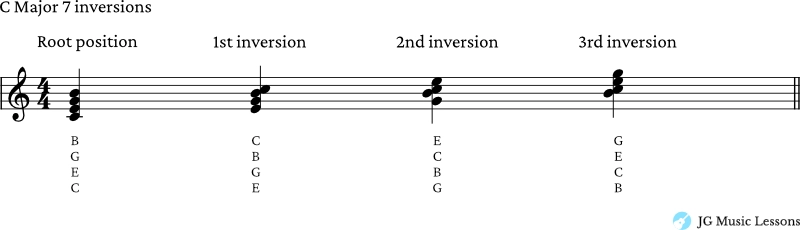
Inversions using Drop 2 Voicings
Now let’s take a look at each of these inversions and drop the 2nd voice. This is what each chord would look like:

Start with one C Major 7 close-position voicing. Identify the second-highest note, move it down one octave, and compare the original voicing with the drop 2 version. Listen for how the spacing changes while the four chord tones stay the same.
The following sections show drop 2 voicings across several string sets. Start with one string set and learn how the four inversions connect before exploring the remaining shapes.
C Major 7 drop 2 chords on the 6th string
Here are the drop 2 chords for C Major 7 starting on the 6th string ordered from a lower to higher range on the guitar.

Here are the same shapes in chart form below.

Play the four C Major 7 drop 2 inversions on this string set. As you move through them, identify which chord tone is in the bass: root, 3rd, 5th, or 7th.
Once the first set feels comfortable, use the next two string sets to find the same four chord tones in other areas of the fretboard.
C Major 7 drop 2 chords on the 5th string


C Major 7 drop 2 chords on the 4th string


C minor 7 drop 2 chords on the 6th string
Now, let’s look at what the drop 2 chords look like for C minor 7 starting on the 6th string.


Compare the same C Major 7 and C minor 7 drop 2 inversion. Notice which notes change when the 3rd and 7th move down one fret, while the overall voicing shape remains related.
C minor 7 drop 2 chords on the 5th string


C minor 7 drop 2 chords on the 4th string


The same drop 2 process can also be applied to other four-note chord qualities, including dominant 7 and half-diminished chords. The Major 7 and minor 7 shapes here give you a practical place to learn the concept first.
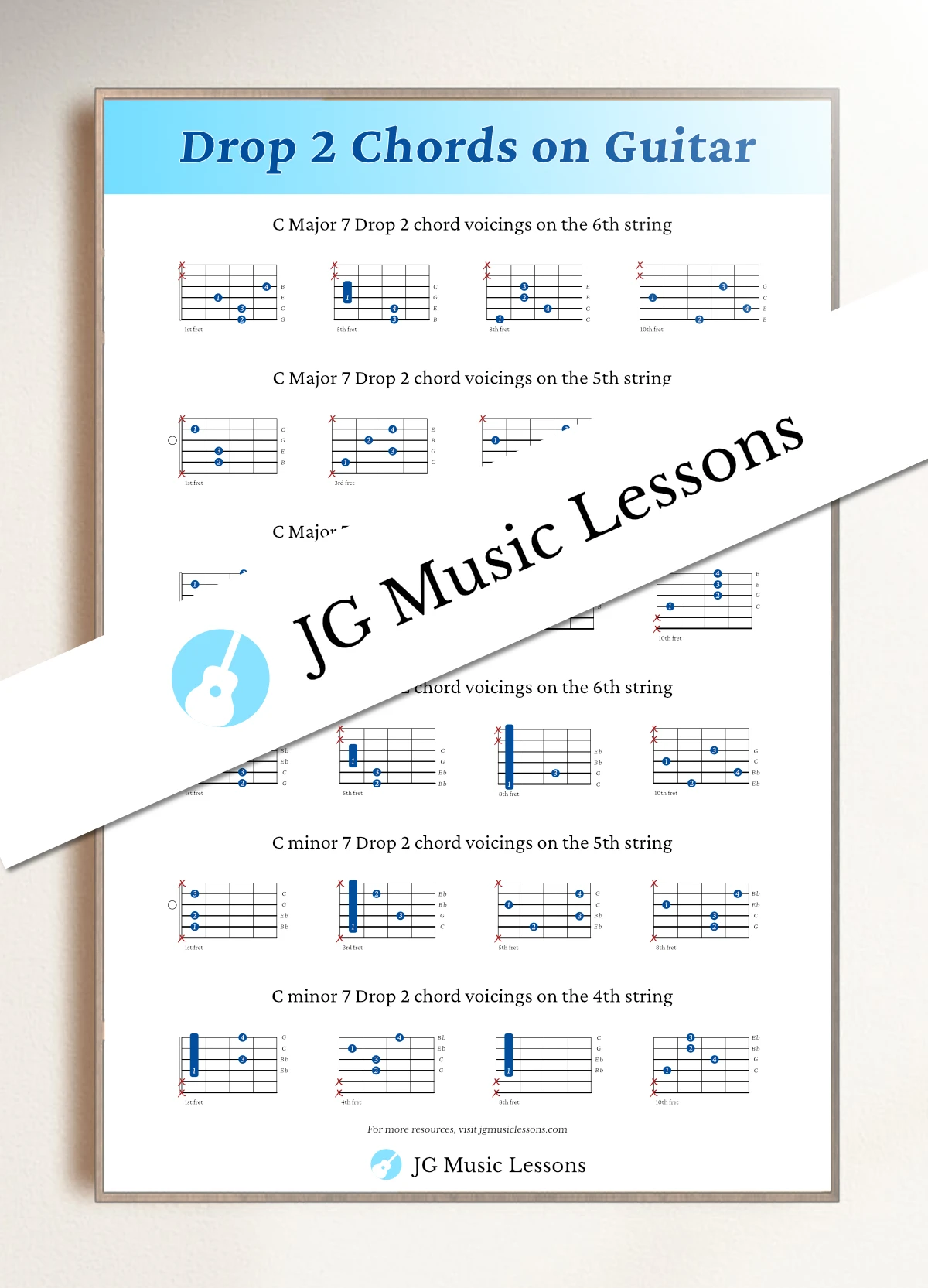
Drop 2 chords application examples
The examples below show how drop 2 inversions can create different sounds while keeping the same chord, and how nearby voicings can make chord changes feel smoother.
Example 1

Play Example 1 slowly and listen to how the harmony stays on the same Major 7 chord while the bass note and note spacing change from one inversion to the next.
Example 2
Now that you know these drop 2 shapes for C Major 7 and C minor 7, the next step is to apply them across different chords.
Add F Major 7 and choose nearby drop 2 voicings so the notes move as little as possible when you change between C Major 7 and F Major 7.

Move between C Major 7 and F Major 7 using nearby drop 2 voicings. Compare that with jumping to distant shapes and listen to how the closer movement changes the flow of the progression.
The remaining examples expand the same idea across longer progressions and different 7th-chord qualities.
Example 3
This example uses drop 2 voicings for several chords that belong to the key of A Major.

Included with Pro
Take this lesson a little further.
This bonus section is included with Pro Membership. Pro also gives you the full Guitar Roadmap to keep your learning in order, plus direct access to me when something isn’t clicking.
Already a member?
Log in →
Included in Pro Membership ✨
Choose a short progression with two or three 7th chords. Stay on one string set and choose a drop 2 inversion for each chord that keeps your fretting hand in roughly the same area of the neck. Play the progression slowly and listen for smooth movement between the voicings.
Wrapping up
Drop 2 chords rearrange four-note chords into wider voicings that fit naturally across the guitar fretboard.
Start with one string set and learn how the four inversions of a Major 7 chord connect. Then use nearby voicings to move between different chords without making large jumps across the neck.
From there, the additional string sets, minor 7 shapes, and progression examples in this lesson give you more ways to expand the same idea across the fretboard.
Before continuing
You’re ready to continue when you can play the four drop 2 inversions of one Major 7 chord on a single string set and use nearby drop 2 voicings to move smoothly between two 7th chords.
Next: Continue in the Mastery Roadmap to keep developing chord voicings and fretboard harmony.
📘 Get the free Practice Blueprint: Build better habits and make your progress more consistent. Download the free guide →