
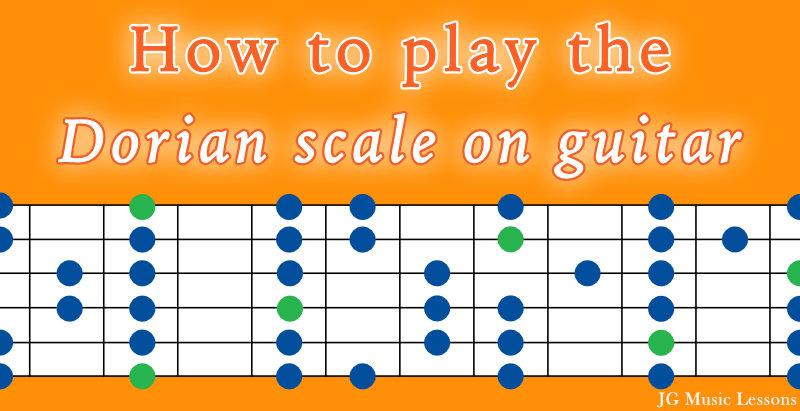
The Dorian scale is a minor-type mode with a natural 6th, giving it a different sound from the natural minor scale.
In this lesson, you’ll learn the Dorian formula, compare it with natural minor, play it across the fretboard, and use its characteristic 6th in musical examples.
Mastery Roadmap Focus · View Roadmap →
Start with one natural minor scale shape and raise the b6 to create Dorian. Listen to how the natural 6 changes the minor sound, then use that note intentionally in a short melodic phrase.
Dorian scale formula
The Dorian scale has the formula 1, 2, b3, 4, 5, 6, b7.
An easy way to understand it is to start with the natural minor scale and raise the b6 by one half step.
- D natural minor: D, E, F, G, A, Bb, C
- D Dorian: D, E, F, G, A, B, C
The natural 6 is the characteristic note that gives Dorian its distinct sound.
We can also look at the dorian scale formula in terms of whole and half steps. The formula would be whole, half, whole, whole, whole, half, and whole step between the scale notes.
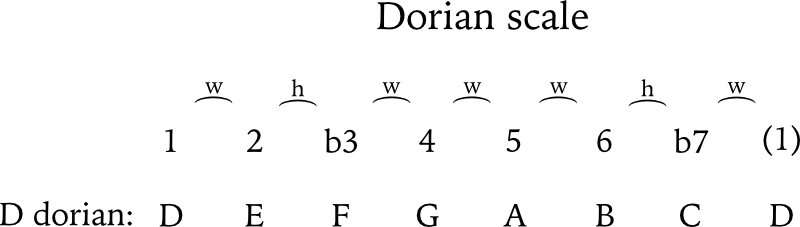
Play D natural minor, then D Dorian. Listen specifically to Bb changing to B. Repeat the two scales and focus on how that one note changes the overall minor sound.
Dorian can also be derived from the 2nd degree of a Major scale. For example, D Dorian uses the same notes as C Major, while G Dorian uses the same notes as F Major.
Dorian scale examples with tabs
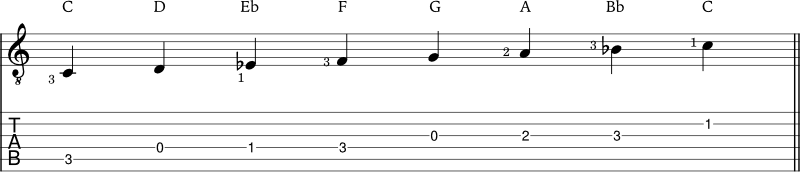
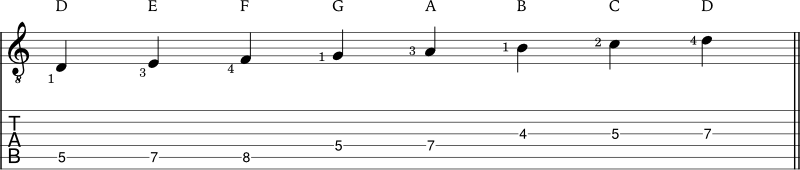
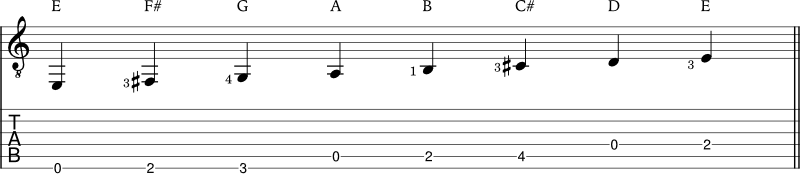
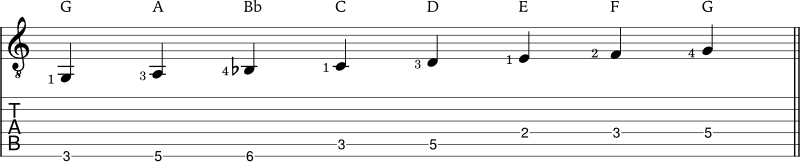
Here are some different Dorian scales in music notation with guitar tabs below. The numbers above the notes on the top staff indicate which fingers to use on your fretting hand. If needed, check out how to read guitar notation symbols.
The examples below show Dorian from several roots. Start with one key and listen for the natural 6 before using the remaining examples as references.
C dorian scale example
D dorian scale example
E dorian scale example
F dorian scale example

G dorian scale example
A dorian scale example
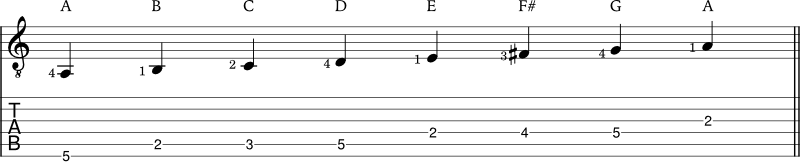
B dorian scale example

Dorian scale chart
Use this chart as a reference when you want to build Dorian from another root. The formula stays 1, 2, b3, 4, 5, 6, b7.
| Dorian scale | 1 | 2 | b3 | 4 | 5 | 6 | b7 |
|---|---|---|---|---|---|---|---|
| C dorian scale | C | D | Eb | F | G | A | Bb |
| D dorian scale | D | E | F | G | A | B | C |
| E dorian scale | E | F# | G | A | B | C# | D |
| F dorian scale | F | G | Ab | Bb | C | D | Eb |
| G dorian scale | G | A | Bb | C | D | E | F |
| A dorian scale | A | B | C | D | E | F# | G |
| B dorian scale | B | C# | D | E | F# | G# | A |
| Db dorian scale | Db | Eb | E | Gb | Ab | Bb | B |
| Eb dorian scale | Eb | F | Gb | Ab | Bb | C | Db |
| Gb dorian scale | Gb | Ab | A | B | Db | Eb | E |
| Ab dorian scale | Ab | Bb | B | Db | Eb | F | Gb |
| Bb dorian scale | Bb | C | Db | Eb | F | G | Ab |
Dorian scale shapes on the fretboard
The following section shows you the 5 dorian scale shapes throughout the guitar fretboard.
How to read the scale charts
For the charts below:
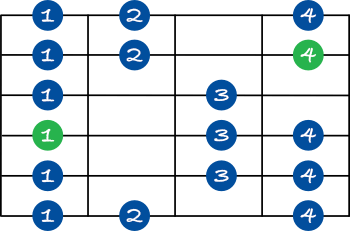
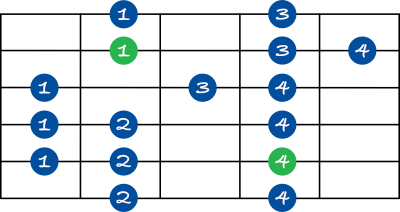
- The lowest horizontal line represents the thickest string (Low E). The top horizontal line represents the thinnest string (high E).
- The green circles represent the root note of the dorian scale and the blue notes are every scale note in between.
- The numbers inside the circles represent the suggested fingering to use on your fretting hand.
If needed, check out how to read guitar notation symbols.
The five shapes below show Dorian across the fretboard. Start with one position that feels comfortable and use the remaining shapes later to expand into neighboring areas.
Dorian scale shape 1
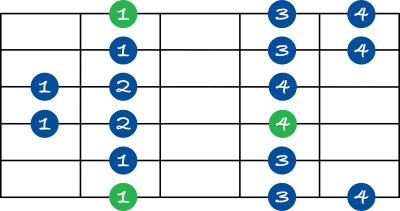
Choose one root and play Shape 1 slowly. Find the root, b3, 6, and b7 inside the shape. Play it again and listen especially for the natural 6.
Dorian scale shape 2
Dorian scale shape 3
Dorian scale shape 4
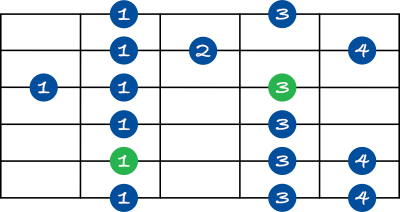
Dorian scale shape 5
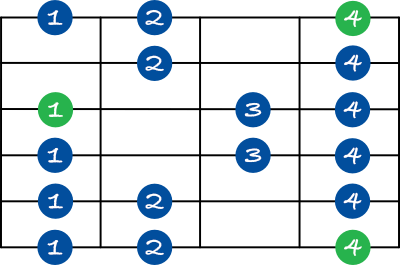
A useful way to learn these positions is to compare them with natural minor shapes you already know. The notes stay the same except for the 6th, which moves up one fret.
Take one familiar natural minor shape, find every b6, and raise each one by one fret. Play the new shape and listen for the Dorian sound.
Dorian scale application examples
Dorian works especially well over minor harmony when the natural 6 fits the chord or progression. The examples below show several ways to hear and apply that sound.
1. Dorian scale example – D minor
For this example, we are using a D dorian scale over the D minor chord.
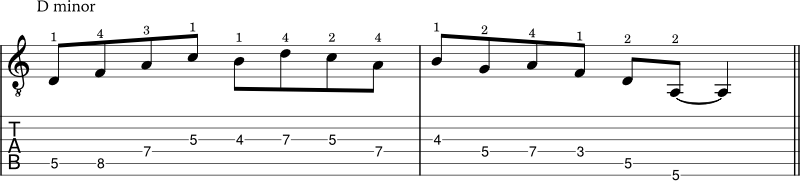
Play the D Dorian example over D minor. Then create a short phrase of your own that includes B, the natural 6. Compare it with a phrase that uses Bb instead and listen to the difference.
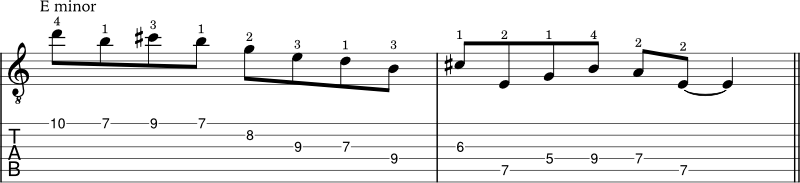
2. Dorian scale example – E minor
Here we are using the E dorian scale over an E minor chord.
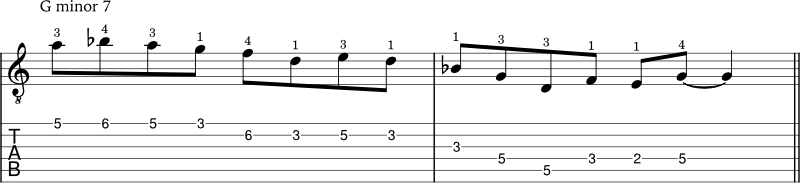
3. Dorian scale example – G minor 7
Like I mentioned, you can also use the dorian scale over minor 7 chords. This is the G dorian scale over a G minor 7 chord.
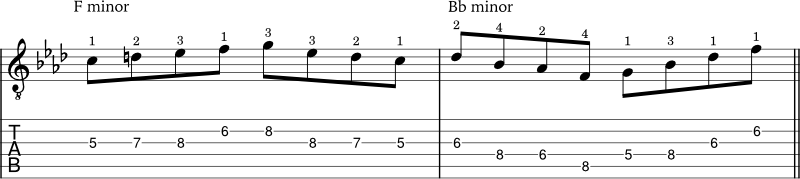
4. Dorian scale example – F minor to Bb minor
This example expands the idea by changing the Dorian root as the harmony changes.
5. Dorian scale example – C minor 7 to F 7
C minor 7 and F7 both belong to the same group of notes as Bb Major. Because C Dorian uses those same notes, you can use C Dorian across this two-chord progression.
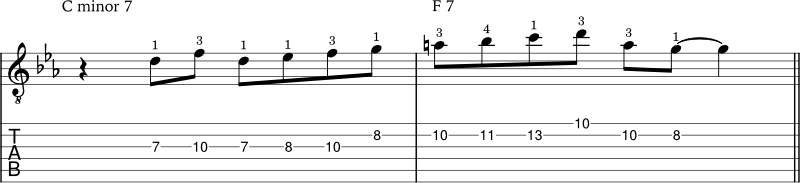
Play through the C minor 7 to F 7 example using C Dorian. Listen for how the same scale can continue while the chord underneath changes.
6. Dorian scale example – A minor
This final example uses notes from A Dorian in harmonized 6ths, giving you another way to turn the scale into a melodic texture instead of playing single-note lines.
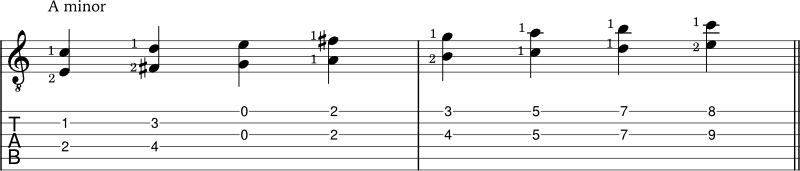
Put on a minor chord or simple backing track where Dorian fits. Using one scale shape, create two short phrases. In the first, avoid the 6th. In the second, include the natural 6 and listen to how clearly that note brings out the Dorian sound.
Wrapping up
Dorian has the formula 1, 2, b3, 4, 5, 6, b7. Compared with natural minor, the only change is the natural 6.
Start with one natural minor shape you already know, raise the b6, and spend time hearing how the natural 6 changes the sound.
From there, the additional shapes and application examples in this lesson give you more ways to use Dorian across the fretboard and in different minor-key settings.
Before continuing
You’re ready to continue when you can turn one natural minor shape into Dorian by raising the b6, identify the root, b3, 6, and b7, and use the natural 6 intentionally in a short phrase over minor harmony.
Next: Continue in the Mastery Roadmap to explore the next modal sound and its characteristic notes.
📘 Get the free Practice Blueprint: Build better habits and make your progress more consistent. Download the free guide →